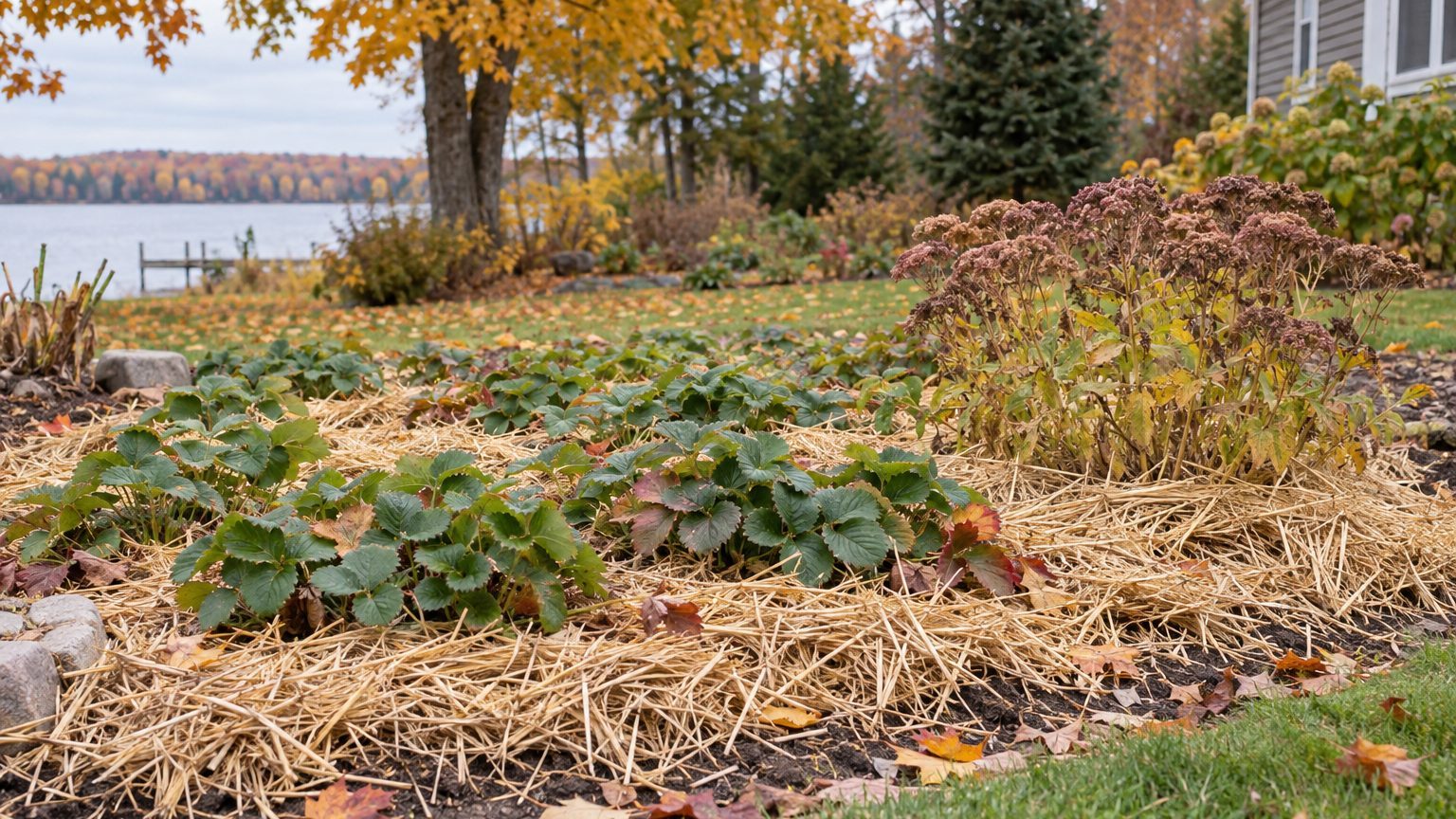

Mulch strawberries after the first freeze, which at New Orleans typically arrives between December 17 and January 8. Some winters bring no freeze at all, and then the mulch does a different job. It holds moisture and suppresses weeds. It also gives you something to pull over the plants on the one cold night the forecast warns about. North Louisiana freezes sooner and more often, so the same calendar slides earlier there. Perennials follow the same logic, with a few plants that need more care than others.
When to put winter mulch down in Louisiana
In cold country, winter mulch has a counterintuitive job. It goes on after the ground starts to freeze, because its purpose is to keep the soil frozen and stop it from thawing and refreezing. Put on too early, it traps warmth and wet against the crowns and gives rodents a place to settle in. South Louisiana plays by different rules, because the ground there rarely freezes.
NOAA’s 1991-2020 Climate Normals for the New Orleans station put the mean daily minimum of the coldest month at 46.1°F. A 32°F freeze occurs in only 86.8 percent of years, so roughly one winter in eight has no freeze at all. When the first one does come, the 30 to 70 percent probability band runs from December 17 to January 8, a window that straddles New Year’s Day. Summer heat, not winter cold, is the limit on what grows well in this part of the state. The USDA Plant Hardiness Zone Map (2023) lists the state as 8a-10a, so use New Orleans as the reference and expect the northern parishes to run colder.
Should you mulch before or after the first freeze?
After. Wait for the first freeze (December 17 to January 8 at New Orleans) before laying winter mulch, and keep straw on hand to cover plants on freeze nights. Spreading a thick layer in October or November, when soil is still warm and fall rains are still coming, holds moisture against the crowns for weeks with no cold to justify it.
The window moves with your location. Mulching moves earlier in the calendar in North Louisiana, which has an earlier first fall freeze and more of them. A gardener near the Arkansas line may be spreading straw before a gardener on the Gulf Coast has seen a single frost. The First and Last Frost Dates in Louisiana show where your area falls. Once the first freeze has come and more cold is in the forecast, the mulch goes on.
Is winter mulch needed in south Louisiana?
For soil temperature, no. Where the winter minimum averages 46.1°F, the soil does not freeze solid and thaw again, so there is nothing for mulch to stabilize. It still earns its place for three reasons. It slows evaporation during the dry spells that follow fall rains, it blocks the winter weeds that sprout in mild weather, and it is already in the bed when a freeze threatens. A gardener who mulches lightly and keeps a bale of straw in reserve is covered in all three situations.
Strawberries
The crown is the part of a strawberry plant that has to live. It is the short, compressed stem at soil level where leaves, flower buds and runners all start. In cold climates, freezing and thawing soil can push crowns up out of the ground, and bare cold can kill them. Neither is the main risk in south Louisiana, where the ground does not freeze. The problems here are open blossoms and flower buds hit by a late freeze, and ripening berries that rot where they touch wet soil. Mulch addresses both.
Use clean straw, meaning the dry stalks left after grain harvest. Hay is cut grass with seed heads attached and will plant a lawn of weeds in your berry bed. Pine straw, the fallen needles that Southern gardeners rake up by the bale, is also a common choice, and it is light, airy and slow to mat. Whichever you use, spread it loosely. For a deeper look at the crop itself, see Growing Strawberries.
Strawberries in Louisiana are treated mostly as a cool-season crop, because the summers are hot and humid. They go in the ground in fall, grow through the mild months and fruit in spring. That means the plants are alive and leafy all winter, and winter mulch is working around them rather than over a dormant bed. Keep the straw between the rows and tucked under the plants with the crowns visible. On a night when a freeze is forecast, pull the straw up and over the plants, or lay a row cover on top. Take the cover off the next morning once temperatures climb. That way the leaves get light.
The NC State Extension Gardener Handbook gives the working depth. It says: “A 2-inch to 3-inch layer of mulch suppresses most annual weed seeds and makes it easy to hand-pull any that do germinate.” That range suits the aisles and the beds between plants. A heavier layer over the crowns is for freeze nights only and comes off the next day.
In spring, uncover based on the plants rather than the calendar. Rake the straw off the crowns as soon as new growth pushes up through it, and leave it tucked under the flower stalks so the berries ripen on clean straw. In south Louisiana that happens in late winter, which is also when the last freeze can still catch open blossoms, so keep the straw nearby for one more cover. Plants left under a thick mat take longer to warm up, grow pale and stretched, and produce fewer flowers. The last frost dates for your area tell you when the cover-up threat is over.
Perennials and borderline plants
The USDA Plant Hardiness Zone Map (2023) sorts the state into zones 8a-10a, and the zone is built on the average annual extreme minimum temperature. In the warm southern end, most true perennials need no winter protection at all. Daylilies, irises, coneflowers and the like handle a Louisiana winter without help, though a thin mulch still keeps moisture steady and weeds down. The plants that benefit from winter mulch are the borderline ones, which a hard freeze will burn back and which need their roots to stay alive until spring.
That group includes cannas, gingers, elephant ears, pentas and lantana. A freeze blackens the tops, and the plants come back from the roots in spring. Roots protected by mulch usually do, and roots in bare, saturated soil are the ones that fail. Rosemary, lavender and other Mediterranean herbs suffer more from cold, wet feet than from the cold itself. For them, mulch should be thin and well drained. Getting Perennial Herbs Through the Winter covers that group in detail. Perennials planted in fall have the least root growth behind them and gain the most from a mulch layer.
Build a ring, not a pile. Lay the mulch after the first freeze has blackened the top growth, and keep a bare collar around the crown itself. Mulch piled against stems holds water against the bark or crown and invites rot, and the plant gets no benefit from the extra depth. For depth, the same handbook gives this guidance for trees: “Provide a 3-inch layer of mulch to reduce water loss and maintain uniform soil moisture and temperature around roots.” That is the ceiling for a ring of shredded leaves, pine straw or bark. Going thicker does nothing more for the roots.
Leave the dead tops standing through the cold months, since they shelter the crown and shed rain, and cut them back in late winter once the worst of the freeze risk has passed. In the northern parishes, where cold snaps come earlier and more often, mulch the borderline plants sooner than you would on the coast, but still after the first hard freeze. The principles of ring placement and depth are covered in Mulching Without Killing the Plant.
What goes wrong
Mulching too early is the most common mistake. In a warm, wet fall, a heavy layer laid down in October or November holds moisture against the crowns for weeks, and the result is crown rot in strawberries and soft, yellowing stems in perennials. Berries that touch damp mulch develop gray mold. The fix is to wait for the first freeze, or to keep the fall layer thin and loose until it comes. Hold the heavy layer back until the first freeze arrives, between December 17 and January 8 at New Orleans.
Mulch that mats and rots is the second problem. Wet straw, leaves or shredded bark pack into a dense, soggy sheet that blocks air from the soil and stays wet for days. Loose pine straw and fluffed wheat straw resist this. Lift and turn the layer after a long rain, and keep it within the 2 to 3 inch range rather than adding more each time it settles.
Rodents are a smaller concern in the south and a bigger one in the northern parishes, where mulch stays on longer and cold snaps are more frequent. A thick, undisturbed pile gives mice and voles a sheltered nest right beside the crowns. They chew the bark and roots, and the damage shows up in spring as plants that fail to leaf out. A shallow layer and a bare collar around each stem remove the cover they want.
Forgetting to uncover is the last. Plants smothered under straw after growth resumes come up pale, with weak stems and few flowers, and strawberry blossoms trapped under the mat never set fruit. Check the beds every week once days begin to warm, and pull the mulch back from the crowns as soon as green growth appears.
Common questions
- Do I have to mulch strawberries in south Louisiana?
- No. The coldest month at New Orleans averages a daily low of 46.1°F, and some winters have no freeze at all. Straw still helps by keeping berries off wet soil and by giving you something to cover plants with on a freeze night.
- What is the best material for strawberry mulch?
- Clean straw or pine straw. Both are light and slow to mat. Hay carries weed seed and should be avoided.
- Can I mulch in October to be safe?
- A thin layer is fine for weeds and moisture, but a heavy layer laid in a warm fall holds water against the crowns and invites rot. The heavier layer goes on after the first freeze, which at New Orleans arrives between December 17 and January 8.
- Do I mulch earlier in north Louisiana?
- Yes. The colder northern part of the state gets its first fall freeze sooner and sees more of them, so winter mulch goes on earlier than on the coast, but still after the first hard freeze.
Sources: ncei.noaa.gov | content.ces.ncsu.edu