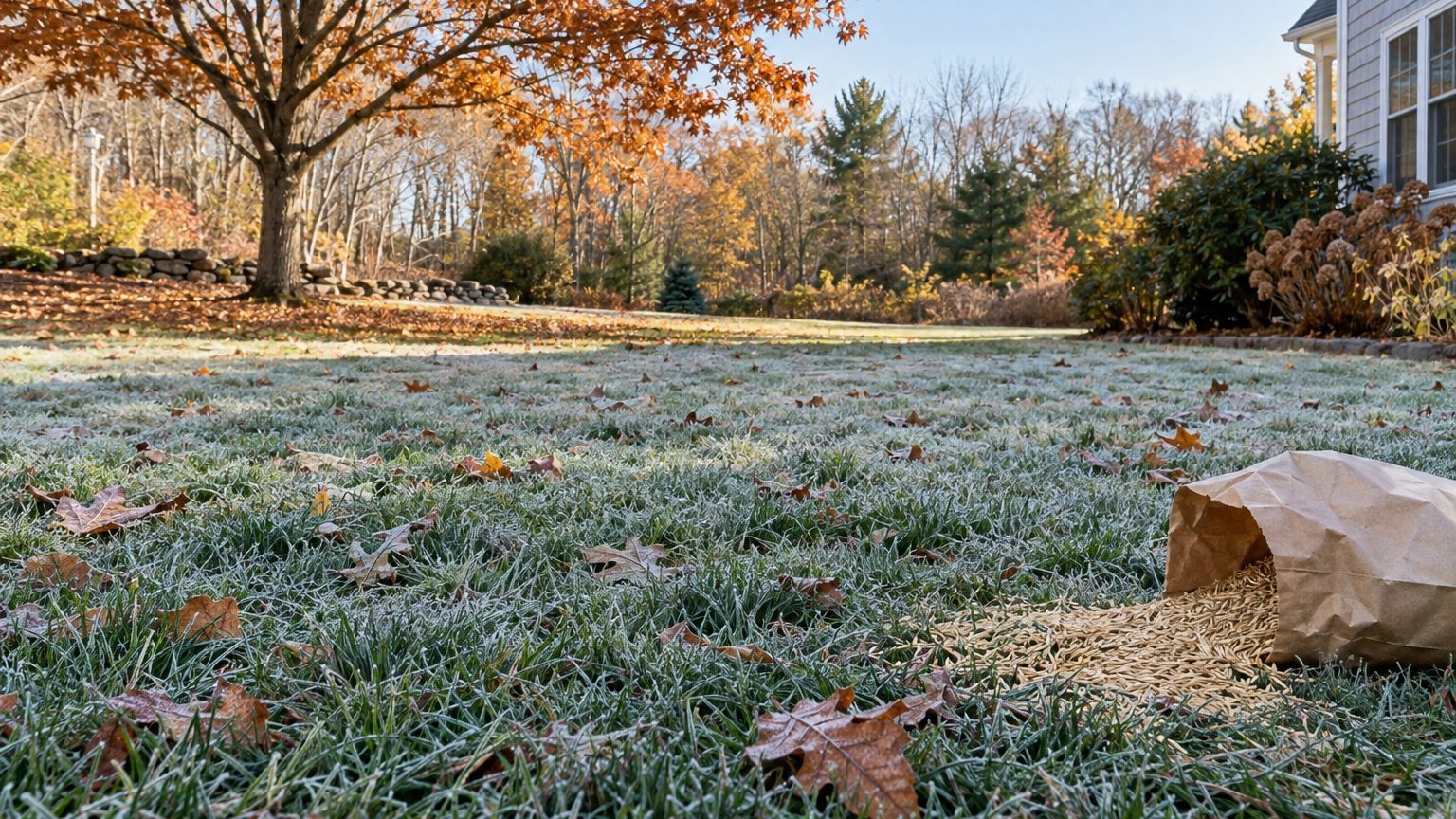

The leaves are down, the September seeding window slipped by, and a bag of grass seed is still sitting in the garage. In the East, spreading it in November works only on a cool-season lawn (Kentucky bluegrass, tall fescue, perennial ryegrass, fine fescue) and only once the soil is cold enough that the seed cannot sprout before spring. That is dormant seeding. The seed lies on the surface all winter, freeze-thaw cycles pull it into contact with the soil, and it germinates by itself when the ground warms, often a week or two ahead of seed sown in spring. Spread it too early, and it sprouts and then dies.
Soil at 2 inches decides the date, not the calendar
Soil cools weeks behind the air. A string of frosty mornings in early November can still leave the top 2 inches of soil in the upper 40s, which is warm enough for a mild week to wake the seed. The usual rule is to wait until soil stays below 40°F. The University of Minnesota and Nebraska Extension both use that figure, and Kansas State allows up to 45°F. A cheap soil thermometer pushed 2 inches into the ground gives you the number. Take it in the morning, a few days in a row, and check that the extended forecast has no long mild stretch coming.
Most of the East is not at that threshold on November 21. Station records put the first date when 2-inch soil drops below 40°F at roughly November 16 in Maine, November 17 in Vermont, November 20 in New York, November 23 in New Hampshire and November 28 in Pennsylvania. Rhode Island averages December 12. Virginia often doesn’t get there until mid-January, and in North Carolina, Georgia, Tennessee and South Carolina the soil usually never falls below 40°F. Dormant seeding is mainly a northern practice. If you are in the Southeast, your cool-season window is closed and spring is the better time.
Why seed sown in mid-November often fails
The failure comes from the gap between the end of normal fall seeding and truly cold soil. From October into early November, soil is still warm enough for seed to germinate, but the seedlings don’t have time to toughen up before the first hard freeze, and tender new grass is what winter kills. A Kansas State and Purdue trial across six cool-season species found that mid-November seeding often behaved like an accidental fall seeding, with winter injury as the result. In the reported Kansas data, Kentucky bluegrass reached only about 24% cover by June. The authors advise waiting until late November at the earliest, with December through February the reliable stretch.
Washout is the second way it fails. Seed that sits on the surface of a slope can move with heavy rain or snowmelt before the freeze-thaw cycles bury it. Flat or gently sloped ground holds seed far better. Steep banks are better served by seed under an erosion blanket or by sod.
Seed choice, rate and surface prep
Kentucky bluegrass is the safest species for a dormant seeding. Purdue prefers it over faster germinators such as perennial ryegrass and tall fescue, which are more likely to sprout during a January thaw. Purdue’s figure for overseeding a thin lawn is about 2 to 3 pounds per 1,000 square feet. Because some seed is lost to birds, wind and runoff, extension guidance suggests adding extra: 10 to 20% more at Minnesota, closer to 25% in the Kansas State and Purdue work. Spread half the seed in one direction and the other half crossways so the coverage stays even.
The seed has to touch soil, so clear the surface first. A mat of oak or maple leaves blocks that contact, and Minnesota’s turf specialists recommend bagging or mulch-mowing heavy leaf litter before you spread. Mowing the lawn short beforehand and raking lightly to scratch the thatch also helps, since seed on thick thatch never reaches the ground. Skip the fertilizer, because seed that isn’t growing can’t use it. Skip the watering too, since moisture only encourages germination. Snow and spring rain will do the job.
A late November decision for different yards
Where the soil already reads under 40°F, in northern New England, upstate New York and the higher ground of the Appalachians, you can seed now on bare or thin cool-season turf. In Pennsylvania, southern New England and the Mid-Atlantic, the soil is probably still above that line. Waiting until after Thanksgiving is the customary rule, and the window runs through early March. Seeding earlier in that window is generally better, because the seed gets more freeze-thaw cycles to settle in. In Virginia and the Carolinas, skip it.
Dormant seeding also limits what you can do in spring. Most crabgrass preemergent herbicides stop turfgrass seed from establishing, so the weed preventer has to wait until the new grass has been mowed a few times.
Source : ask.extension.org