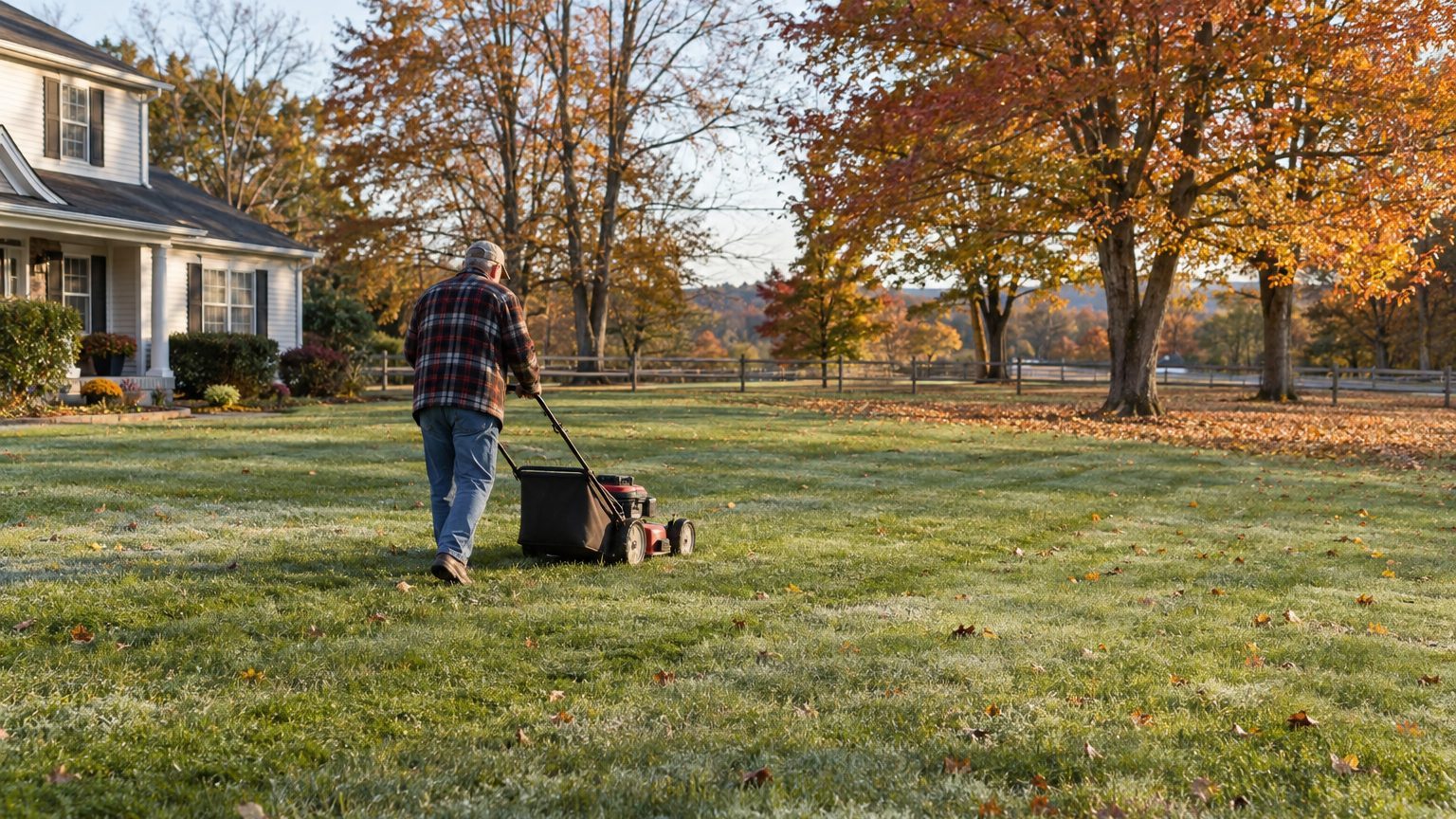

Stop mowing when the grass stops growing, which for most of the country means somewhere between late October and early December. The final cut should leave cool-season grass at about 2 to 2.5 inches, roughly a half inch to an inch shorter than your summer height. Those two numbers cover most American lawns, though the calendar date depends heavily on where you live.
The calendar matters less than the thermometer
Cool-season grasses like Kentucky bluegrass, tall fescue and perennial ryegrass grow actively when soil temperatures sit between roughly 50 and 65 degrees. Once soil drops below about 50, growth slows to a crawl. Below 40, it basically quits.
A cheap soil thermometer, usually under $15 at a garden center, beats guessing. Push it 2 to 4 inches into the ground in the morning for a few days running. If readings hover in the low 40s, you are done.
In the Upper Midwest and Northeast, that point often lands in late October or early November. Minnesota and Maine lawns may get their last mow before Halloween. Pennsylvania, Ohio and Indiana typically mow into early November, and the Mid-Atlantic can stretch toward Thanksgiving.
Warm-season lawns follow different rules. Bermudagrass, zoysia and St. Augustine go dormant after the first hard frosts and turn tan, usually from October in the upper South to December along the Gulf Coast.
Dormant grass doesn’t need cutting.
Transition-zone yards (think Tennessee, North Carolina, Kentucky, Missouri) are the tricky ones. Tall fescue may still be growing in November while a neighboring bermudagrass lawn sits brown. Mow what is actually growing, not what the neighbors are doing.
How short the last cut should be
Aim for 2 to 2.5 inches on cool-season turf. Mowing much taller leaves long blades that flop over under snow and mat down, creating a damp, cozy layer where snow mold fungus thrives. Gray and pink snow mold show up in spring as circular, crusty patches, and they are most common in northern states where snow sits on unfrozen ground for weeks.
Mowing much shorter causes a different problem. Grass blades are the plant’s solar panels, and scalping a lawn to 1 inch or less strips its ability to store energy for winter. Crowns and shallow roots also lose insulation and face more cold and desiccation damage, especially in windy, snow-free stretches common on the Plains.
Step down gradually rather than dropping in one go. If you’ve been mowing at 3.5 inches, take it to 3 inches for the second-to-last pass, then to 2.5 for the finale. The old rule that you never remove more than one third of the blade in a single mowing still applies in fall, and ignoring it is how lawns end up stressed right before winter.
Warm-season grasses are a special case. Most of them shouldn’t be cut shorter in fall at all, because the extra height protects them through their dormant stretch. Many homeowners with bermudagrass keep their normal height through the last mow and then leave it alone. Scalping warm-season turf is a spring job, done just as it greens up.
Leaves, mulching and the rest of the fall checklist
Fallen leaves are the other half of the equation. A thick blanket of wet maple or oak leaves smothers grass just as surely as tall growth does, and it blocks the light the lawn still uses on mild November days.
The easiest fix is to run the mower over them. A mulching mower chops leaves into pieces about the size of a dime, and those fragments sift down between the blades and break down over winter. Research from Michigan State University found that mulched leaves did not harm turf and even suppressed dandelions in test plots. Leaves that are too deep to mow through in one pass should be raked or bagged, or run over twice.
Fall is also the best time to feed cool-season grass. A late-season application of nitrogen fertilizer, commonly applied between mid-October and mid-November once top growth slows, goes largely into roots and stored carbohydrates rather than leaf growth. The lawn greens up faster in spring and handles stress better. Check your state’s rules first, since some states, including Minnesota and Maryland, restrict fertilizer timing or phosphorus content.
A few other end-of-season chores are worth the half hour each takes:
- Sharpen the mower blade, since dull blades shred grass tips and invite disease.
- Drain or stabilize the gas so it doesn’t gum up the carburetor over winter.
- Rake or blow any remaining debris off the lawn before snowfall.
- Avoid parking, stacking firewood or piling gear on the turf.
Overseeding thin patches works best in early fall, so by the time you reach the last mow, that window has usually closed in northern states. In the South, though, ryegrass overseeded onto dormant bermudagrass can keep a lawn green through winter, and those lawns will keep needing mowing at about 1.5 to 2 inches through the cold months.
Signs you can put the mower away
Watch for three signals. The grass stops visibly growing between mowings, a hard frost has hit several mornings in a row, or the lawn looks the same height a week after you last cut it. Any of those means the season is over.
One more trick: if you aren’t sure, mow once more on a dry afternoon in the 40s and check the clippings. Tiny, sparse clippings suggest growth is winding down. A bag full of them means the lawn still has something to say.
Dry grass cuts cleaner too, and a frosted lawn shouldn’t be mowed or walked on until the frost melts, because frozen blades snap and leave brown footprints that can linger into spring.
Keep a note of the date you finished this year. Lawn calendars shift by a week or two from year to year, and having your own record of the last cut, the height, and the weather will tell you more about your yard than any generic guide can.