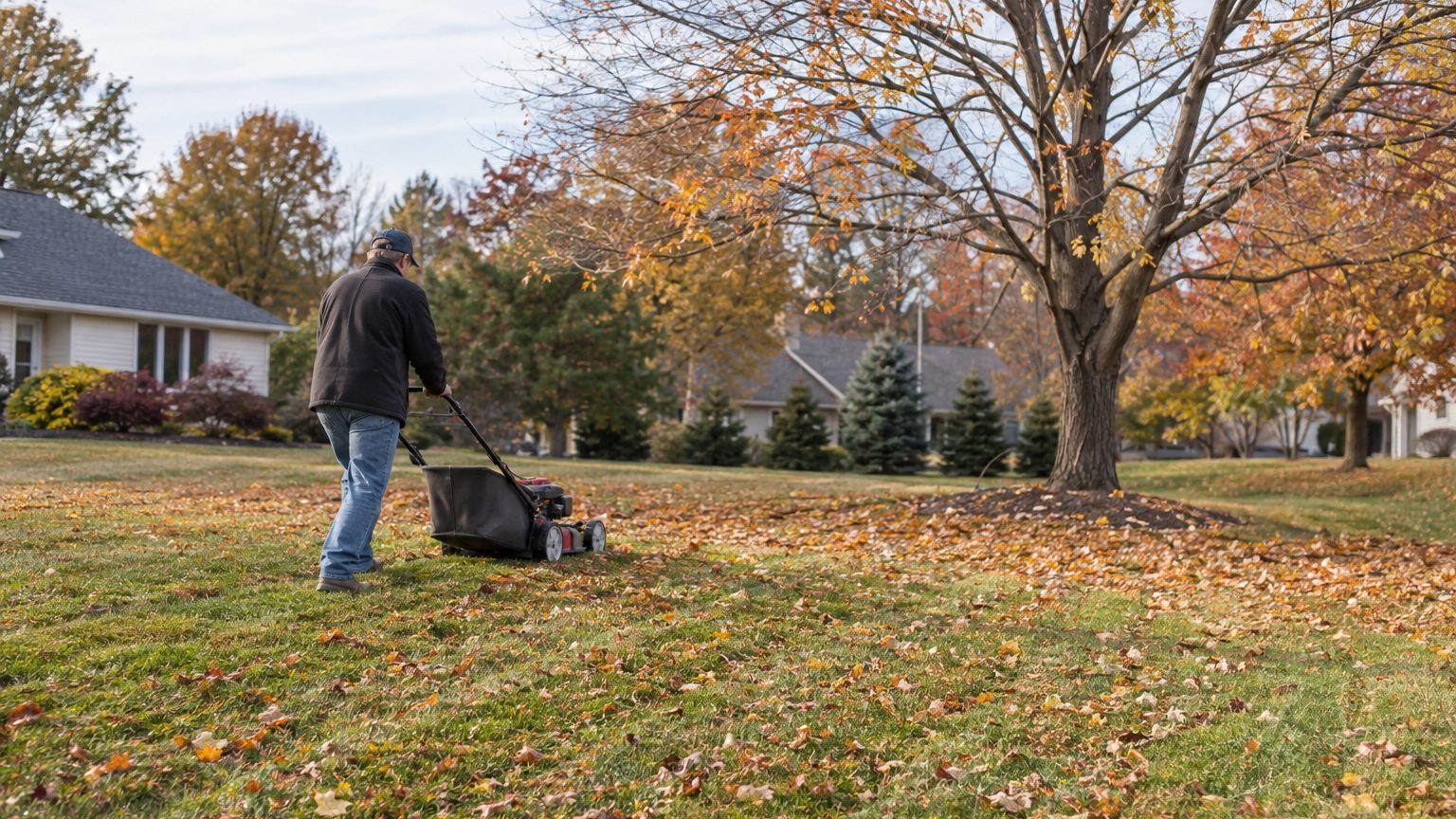

A thick layer of whole leaves left on grass all winter will smother it. A thin layer, or leaves chopped into small pieces, will feed it. That difference decides everything, and it comes down to about three inches of depth and one pass with a lawn mower.
What leaves actually do to turf
Grass needs light. Even in dormancy, cool-season varieties like Kentucky bluegrass, fescue and perennial ryegrass keep some green tissue that photosynthesizes on mild days, and a soggy mat of maple or sycamore leaves blocks that light entirely.
Wet leaves also trap moisture against the crown of the plant. By spring you can find matted, pale patches where snow mold (a fungal disease that thrives under cold, damp cover) has moved in. Gray and pink snow mold are both common across the Upper Midwest, the Northeast and the northern Plains, and a heavy leaf layer is basically an invitation.
Whole leaves are not the enemy everywhere, though. In a flower bed or under a shrub border, they are free mulch.
Lawns and beds follow different rules.
Leaves also hold real value. A study from Michigan State University found that mulching leaves into turf for several years reduced dandelion and other broadleaf weed counts, likely because the layer blocks light to weed seeds. The same research found no harm to turf quality. Fallen leaves return a large share of the nutrients a tree pulled from the soil, and trees drop thousands of them, so tossing them in the trash means throwing away fertilizer you would otherwise pay for.
The mulching method that works
Mow the leaves. That is the whole trick. Run a mower over them with the deck set to a normal height (around 3 inches for most cool-season lawns), and make a second pass if the leaves are deep. You want pieces about the size of a dime or smaller, small enough to sift down between the grass blades and touch the soil.
A mulching blade helps, but a standard blade works fine if you go slowly and overlap. Bagging attachments are optional. If you can still see the grass through the shredded material when you finish, you are in good shape. If the lawn looks like a brown carpet, you left too much.
Dry leaves chop best. Wait for an afternoon after a couple of dry days, because wet leaves clump, clog the deck and leave wads that smother turf anyway.
Timing matters as well. Mulch weekly or every other week during peak drop rather than waiting for the last leaf to fall, because a foot-deep pile is far harder to handle than a light dusting. Research from the university turf programs suggests that you can safely work in leaf cover up to roughly 6 inches deep on a lawn if you shred it, though that is a ceiling rather than a goal. Most homeowners find the sweet spot is a visible layer of confetti with grass still poking through.
Oak leaves get a bad reputation for being acidic and slow to rot. Shredded, they break down fine, and the effect on soil pH is small enough that you can ignore it for a typical lawn.
When raking is still the right call
Some yards do need the rake. If your trees drop leaves so heavily that you cannot get below 6 inches of cover even after repeated mowing, you will have to remove some. The same goes for large, leathery leaves like sycamore or magnolia, which resist shredding and form stubborn mats.
Disease is another reason. If trees on your property had leaf spot, anthracnose or apple scab this year, those fungi overwinter in fallen foliage and reinfect the tree in spring. Raking and bagging (or hot composting) breaks that cycle. The same logic applies to black walnut leaves near vegetable gardens, since walnut produces a compound called juglone that stunts some plants.
Newly seeded lawns also deserve a clear surface. Seedlings are too small and too fragile to push through any layer.
Where you put the raked leaves matters more than people think. Pile them along the fence line, bury them in a vegetable bed as winter cover, or build a simple wire bin and let them become leaf mold, a dark, crumbly soil conditioner that takes about a year or two to form. Gardeners prize it for holding moisture in sandy soil. Many towns also run curbside leaf pickup that turns the material into municipal compost, so check your local schedule before you buy a single paper bag.
Bagging them in plastic and sending them to a landfill is the worst option. Leaves make up a large share of yard waste in the U.S., and several states, including New Jersey and Pennsylvania in some municipalities, restrict or ban yard waste in regular trash.
Wildlife and the case for leaving some alone
Beyond the lawn, leaf litter is a winter home. Fireflies, many native bees, luna moth pupae and a long list of overwintering insects shelter in it, and birds like towhees, thrushes and wrens forage there for protein through the cold months. Some conservation groups now encourage homeowners to leave a section of the yard, usually under trees or in a back corner, completely unraked.
You do not have to choose one approach. A workable compromise: mulch-mow the open lawn, rake leaves off walkways and driveways (where they turn slick and stain concrete), and leave a leafy zone beneath Trees and Shrubs. Keep the pile away from your house foundation and wood siding, since moist debris against a structure can attract termites, carpenter ants and rodents.
One practical note for spring: wait until daytime temperatures hold steady near 50°F before clearing out garden-bed leaf cover, since many beneficial insects are still dormant inside it until then.