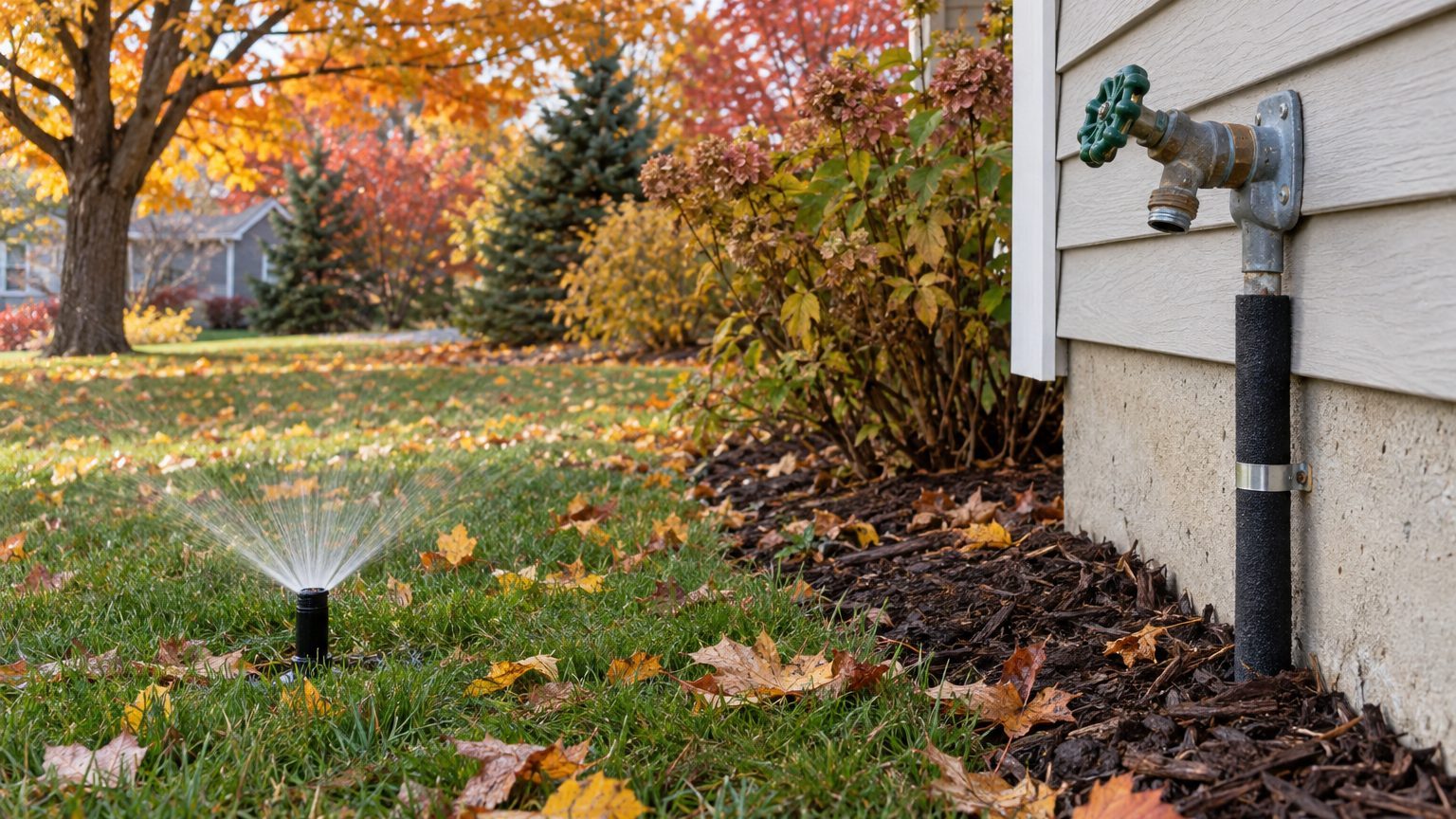

In south Louisiana, winterizing outdoor water is a short job. Shut off the supply to the sprinkler system, drain the low points by hand, pull the hoses and cover the exposed hardware. Do it before the first freeze, which at the New Orleans reference station most likely arrives between December 17 and January 8. Farther north, freezes come earlier and more often, so the same work needs to happen sooner and gets more thorough.
When to do it in Louisiana
Finish the work in the weeks ahead of the first fall freeze. NOAA’s 1991-2020 Climate Normals place that freeze between December 17 and January 8 at New Orleans. They use the 30 to 70 percent freeze-probability band for 32°F. The rule is to act before the first hard freeze, not after the first light one. A light freeze grazes 32°F before sunrise, while a hard freeze holds below it for hours and is the one that splits fittings. Because the calendar sets no firm date, a cold forecast is the trigger to finish, and the work should already be done by then.
The window straddles the New Year because winters here are mild. The average overnight low in the coldest month at New Orleans is 46.1°F, according to the same NOAA normals. A 32°F freeze shows up in only 86.8 percent of years at that station, so roughly one year in seven has no freeze at all. The USDA Plant Hardiness Zone Map 2023 puts Louisiana in zones 8a-10a. The zone is set by the average annual extreme minimum temperature. That is why a mild average coexists with real danger on that one night.
What is worth doing when a full blowout is overkill?
In most of south Louisiana, a complete compressed-air blowout is often unnecessary, because buried pipe sits in soil that rarely gets cold enough to matter. The parts that fail are the ones standing in open air. A short fall routine covers them:
- Turn off the water supply to the irrigation system and set the controller to its off or rain mode.
- Open the manual drain valves at the low points of the lines.
- Insulate the above-ground backflow preventer and any exposed pipe and risers.
- Disconnect and drain every garden hose.
- Cover each outdoor spigot.
Then a surprise cold front finds everything ready, and a mild winter costs you nothing but an hour.
Does the timing change in north Louisiana?
The colder north has an earlier first fall frost and a more reliable freeze, so the work moves earlier there, ahead of the south’s December 17 start. Where freezes are routine, a blowout or a thorough manual drain is worth the effort every year. Local parish extension offices can tell you the typical first-freeze timing for your area, and more Louisiana guides cover regional differences.
Plan to be done before the December 17 to January 8 window opens, and earlier in north Louisiana.
Sprinkler lines: drain or blow out
Water expands as it turns to ice. Inside a rigid pipe, a valve body or a fitting, the ice has nowhere to go, so the plastic cracks or the brass splits. The damage is often a hairline crack that does not leak until the system is pressurized in spring. Pipes full of water sit in the same cold as the air around them. The exposed ones go first: the backflow preventer, the risers that stick up from the ground, and valves in shallow boxes. Three methods empty the system, and they differ in effort, risk and cost.
| Method | How it works | Who does it | Best fit |
|---|---|---|---|
| Manual drain | You close the supply, then open valves at low points so gravity empties the lines | Homeowner | Systems with drain valves, in climates with brief cold snaps |
| Automatic drain | Valves at low points open on their own when line pressure drops and let the water out | Built into the system | Systems installed with them, as a backup layer |
| Compressed-air blowout | A compressor pushes air through each zone and forces the water out the heads | Professional or experienced owner | Long freezes, systems with no drains, areas where deep cold is normal |
A manual drain is usually enough in south Louisiana. Cold snaps there are short, and buried lines are insulated by the soil. Closing the supply and opening the low-point drains gets the water out of the places that matter. Automatic drain valves help if the installer fitted them, but they can stick open or closed from grit, so check that water comes out when you shut the supply.
North Louisiana freezes far more reliably, so a blowout there is a sound yearly habit. Done wrong, it does harm. Air must go through one zone at a time, with eye protection on and nobody standing over a head. Too much pressure can burst the same pipes you are trying to protect, and running air through a zone longer than needed overheats the heads. The compressor also has to move enough air for the zone, which is why a small pancake unit often falls short.
For south Louisiana, shut the supply and drain by hand at the low points; reserve the blowout for the northern parishes.
Call a pro if the system has no manual drains, if you cannot find the shutoff, or if the backflow preventer is mounted high and exposed. The same goes for long zones that run uphill and for any system you did not install and have never drained. A technician brings the right compressor and the knowledge of each zone’s pressure limit, and can tell you at the same visit whether the valves and backflow device need insulation. A drained system also makes sense when you are shutting off irrigation ahead of the lawn’s own rest period, as in Winterizing a Lawn.
Outdoor faucets and hoses
The steps for an ordinary outdoor spigot involve nothing more than turning valves:
- Unscrew every hose, including splitters and timers, and drain each one before coiling it.
- Find the shutoff valve for that spigot inside the house, often under a sink, in a utility room or in a crawlspace, and close it.
- Open the outside spigot and let it run until it stops dripping.
- Leave the spigot open through any freezing night so there is no standing water to expand.
Any plumbing beyond turning valves, such as adding a shutoff where none exists or replacing a failed spigot, is a plumber’s job. Many slab-on-grade houses have no interior shutoff for outdoor taps. If yours has none, skip steps two and three, drain the hose and cover the spigot, and ask a plumber about adding a valve. For the full routine in colder places, see Winterizing Outdoor Faucets Before the First Freeze.
A frost-free faucet puts its valve seat at the inner end of a long barrel, so the seat sits inside the warm wall. The barrel tilts slightly downward, so when you close it the leftover water runs out the spout. A hose screwed onto the spout, even one with a closed nozzle, traps water in the barrel and keeps air from entering behind it. The barrel stays full, and one night of freezing splits it inside the wall. The leak hides until spring, when you turn the water on and it sprays behind the siding.
The fix is as simple as the cause: disconnect the hose before cold nights and let the barrel drain. You can read more about how these faucets work in Frost-Free Outdoor Taps.
An insulated spigot cover, left on, buys time in a short snap but does nothing for a hose still attached. Pull every hose before the first hard freeze, in the weeks ahead of the December 17 to January 8 window.
What goes wrong here
The most common failure is the early cold snap that arrives before anyone has drained. The December 17 to January 8 range is the middle of the spread, so some years bring a freeze before it and some bring none. A mild fall makes it easy to put the job off, and one clear, calm night after a front is enough to catch an undrained system. The sign in spring is a spigot that sprays, a wet stain on the wall below it, or a zone that never builds pressure. The prevention is to finish the routine early in the season and not let a long run of warm days make it look unnecessary.
The forgotten hose comes next. A hose left on a frost-free faucet through one hard night will have split the barrel behind it. The first spring turn-on shows it. It appears as a spray or a damp spot on the inside wall or ceiling. A hose left coiled on a regular spigot can freeze solid and crack too, but the damage there is cheaper. A quick walk around the house with a flashlight or in daylight, checking each spigot, is worth doing. If a pipe does freeze, Frozen Pipes explains how to thaw it safely.
A valve box can flood as well, and the cause is the rain Louisiana gets, since the ground is wet through much of winter. A box set low in the lawn fills with water and silt, and the valves sit submerged during the coldest hours. The signs in spring are a zone that will not shut off, a trickle at one head, or a box full of mud and standing water. Before the first cold front, lift each lid, check for water and debris, scoop out what has collected, and set the lid back firmly. Open every valve box before the first hard freeze and clear it out. When you turn the system on in spring, bring pressure up slowly and walk each zone looking for a geyser or a head that gushes.
Common questions
- Do I need to winterize my sprinklers every year in south Louisiana?
- Yes, but the job is small. Most winters bring at least one freeze, and a single night can crack an exposed backflow preventer or riser. Shut off the supply, drain the low points, cover the exposed parts and set the controller off each fall. A full blowout is optional there and routine in the north.
- When should north Louisiana homeowners start?
- Earlier than the south, because the colder north has an earlier first fall frost and more freezes each winter. Start ahead of the New Orleans range of December 17 to January 8, and finish when forecasts first show nights near freezing. The parish extension office can give the typical first-freeze timing for your area.
- What if a freeze is forecast and I have not drained anything?
- Shut off the water to the irrigation system, open the manual drains, and pull every hose. Cover each spigot and the backflow preventer with an insulated cover made for the purpose, not with plastic, which holds moisture against the pipe. If the freeze is brief, those steps usually protect the system until you can finish the drain properly.
- Should I cover the backflow preventer?
- Yes. It stands above ground on the supply line and is the part of a sprinkler system most exposed to cold air. An insulated cover or bag sized for it, put on before the cold arrives and kept dry, is enough protection for a brief freeze in the south. In the north, drain it as well.
Sources: ncei.noaa.gov