
A mouse can get through a hole about as wide as a pencil, roughly ¼ inch. The University of California’s Integrated Pest Management program (UC IPM) puts the numbers more exactly: house mice can slip under a gap ¼ inch tall and through an opening ⅜ inch wide. The CDC’s measure is a pencil, and UC IPM gives those two dimensions. Your garage almost certainly has a few gaps that size, and the bottom of the overhead door is usually the biggest one.
Start at the garage door
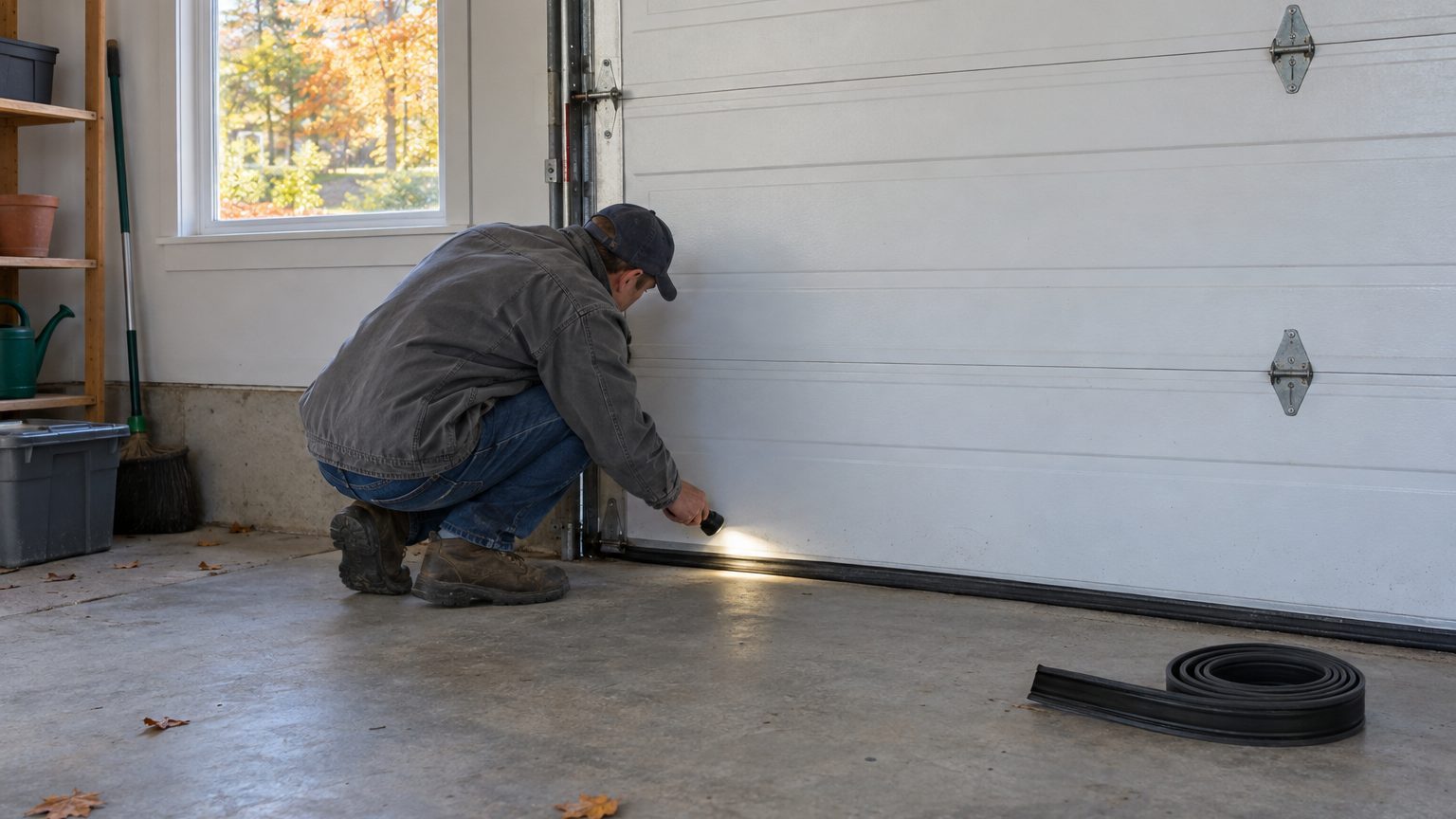
Most mice get in under a worn garage door bottom seal. Look for daylight along the floor with the door closed. Cracked, flattened or chewed rubber needs replacing. A door that sits crooked or won’t close fully leaves an uneven gap, and that usually means a spring, cable or opener adjustment, not just a new seal.
Rubber and vinyl are not chew-proof. UC IPM says door edges may need covering with metal to stop gnawing, and it lists rubber and vinyl among the materials mice chew through. If your slab is uneven, a threshold strip on the floor can give a tighter seal. Check the side and top seals too, and the weatherstripping on the door that leads into the house.
Timing matters. UC IPM says house mice that live outdoors often move indoors in autumn as nights get colder. In the Northeast and Appalachians, that means finishing the work before the first hard freezes, usually by late October.
Plugging holes in the walls
Walk the perimeter with a flashlight and check where pipes, electrical lines, cable and gas lines pass through the wall. Also check old cable holes, vents, and the line where the foundation meets the sill. The CDC’s method is to stuff the hole with steel wool, then put caulk or spray foam around the wool to keep it in place.
Pack it correctly. Tear off a golf ball-sized piece of coarse steel wool and press it deep into the gap until you feel solid resistance. A screwdriver or the eraser end of a pencil works for pushing it in. Leave the wool slightly recessed below the surface so the caulk has a clean edge to grip. If the wool moves when you press it with one finger, it is too loose, because mice will pull at any slack.
Foam by itself does not work. UC IPM lists expanding foam among the materials that do not work for plugging mouse holes. Plain steel wool has a weakness of its own. UC IPM warns that it works as a temporary plug but can rust. In damp spots near a slab edge, stainless or copper wool lasts longer.
Gap size decides the material:
- Gaps under about 1 inch: coarse steel wool, sealed over with exterior-grade caulk.
- Openings over 1 inch, plus vents: ¼-inch mesh hardware cloth cut with tin snips, with at least a 1-inch overlap on solid material.
- Cracks in a concrete foundation: mortar patch or hydraulic cement, after clearing out debris.
- Large structural holes and door gaps: sheet metal or flashing.
Fasten hardware cloth with screws and metal washers. Staples can be worked free as mice push against the mesh repeatedly. If a shed or garage has a dirt floor, lay a skirt of metal hardware cloth around the perimeter so they can’t dig under.
Vents deserve the same treatment. Roof, soffit and gable vents are reached by climbing, and mice scale walls, branches and utility lines to get there. Cover each one with ¼-inch hardware cloth secured with screws. The mesh still lets air through.
Dealing with what’s already inside
Sealing locks in whatever is already in the garage. If you hear scratching or find droppings, set snap traps along the walls before you close the last holes. UC IPM calls trapping the preferred method in garages with a few mice, and exclusion the most permanent control. Rodenticides are the weaker choice. They can harm pets and wildlife and may be restricted in your area.
Then take away the reasons to stay. Pet food, birdseed and grass seed belong in sealed metal or thick plastic containers. Cardboard boxes make easy nesting material, so swap them for plastic bins and keep them off the floor and away from the walls. Ultrasonic repellers are a poor substitute for any of this, since mice quickly adapt to the sound frequencies.
The materials are cheap. DIY sealing of the common entry points typically runs $50 to $150 in materials, covering steel wool, caulk, hardware cloth and a door sweep. A new bottom seal is often the single most useful part of that.
Sources : pestpatrolpdx.com | bbpest.com