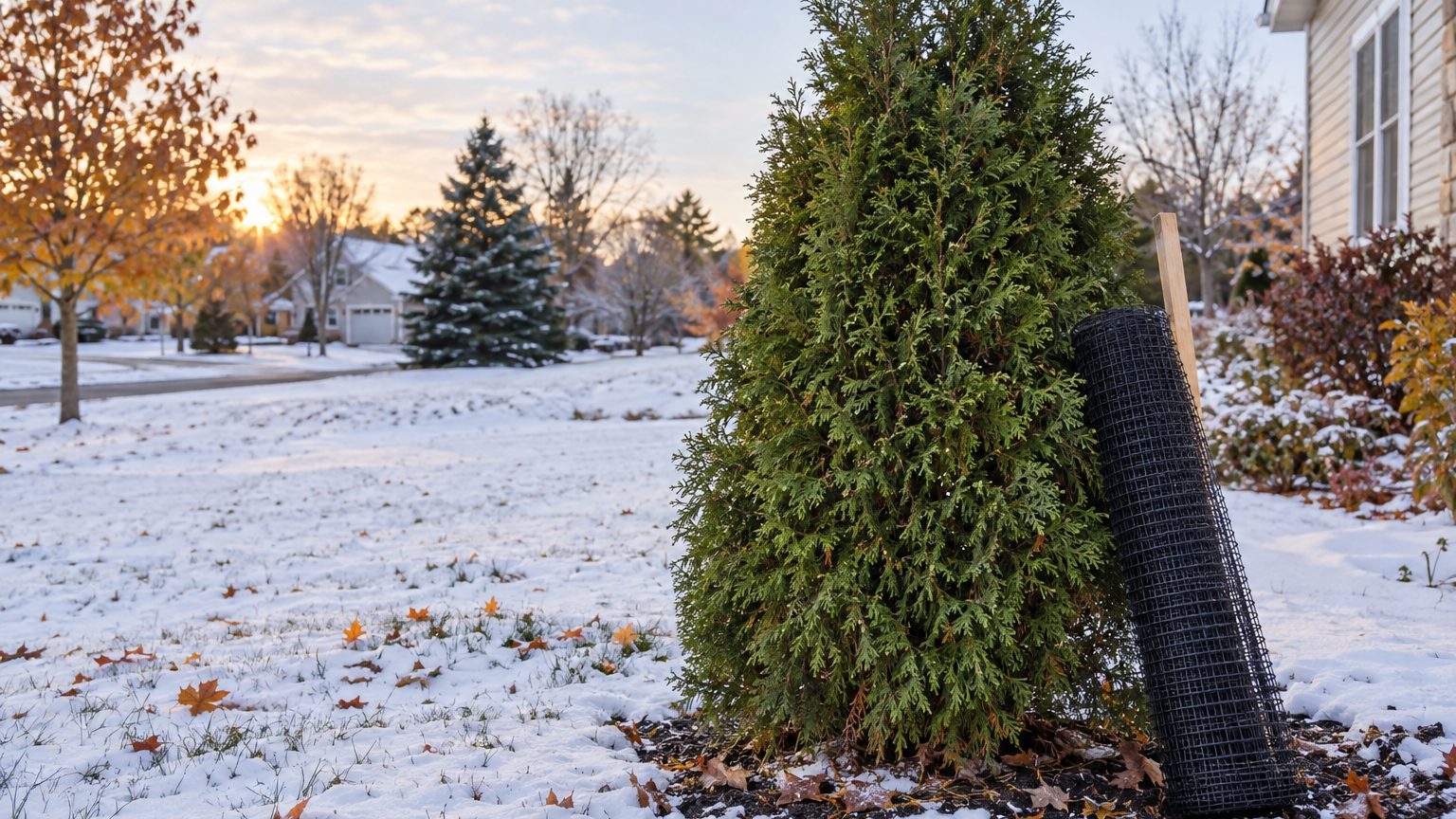

Deer will strip an arborvitae bare from the ground up to about six feet, and winter is when they do the most damage. Eastern white-tailed deer can eat 5 to 10 pounds of vegetation a day, and once snow buries the grass and acorns, the evergreen hedge in your front yard starts looking like a buffet. Arborvitae (Thuja) sits near the top of the menu in many states, especially in the Northeast, Midwest and Mid-Atlantic.
The good news is that protection works, if you match the method to the pressure in your area.
Why Arborvitae Gets Hit Hardest in Winter
Deer don’t eat arborvitae in summer nearly as much as they do in January. Cold weather shrinks their food options, and the dense, fat-rich foliage becomes a reliable calorie source. Browsing typically peaks from December through March, when deer have burned through fall mast and are fighting to hold weight.
The damage has a signature. Deer have no upper front teeth, so they tear foliage rather than clip it, leaving ragged edges and a clean “browse line” at roughly 5 to 6 feet. Younger plants suffer worst, since a single heavy browsing can take most of a 3-foot sapling.
Bucks add another problem in fall. They rub their antlers on trunks, which strips bark and can girdle thin stems.
Cultivar matters too. ‘Emerald Green’ and ‘Techny’ are popular and frequently chewed, while ‘Green Giant’ (technically a hybrid thuja) tends to be somewhat less favored, though not immune when deer are hungry. No evergreen is truly deer-proof. Hungry animals eat almost anything.
Physical Barriers: The Only Near-Guarantee
Fencing wins. Nothing else comes close.
A full perimeter fence for a yard is expensive, and deer can clear 8 feet when motivated. For a single hedge or a few specimen trees, though, a standalone enclosure is far cheaper and just as effective. Drive 6-foot stakes around the plant, leaving a gap of about a foot between the stakes and the foliage, and wrap the frame with heavy-duty plastic deer netting or welded wire. The gap matters because deer can nibble right through a barrier that touches the branches.
Plastic deer netting with a 3/4-inch mesh is sold in rolls at most farm and garden stores and costs a fraction of metal fencing. It’s lightweight, easy to cut and holds up through one or two winters, though heavy ice and wet snow can sag it. Check it after storms.
Burlap gets recommended often, and it has a role, but a limited one. Wrapped loosely around the plant, it blocks sightlines and shields foliage from salt spray and winter wind, which also burns arborvitae. A hungry deer will still push through it or eat what pokes out, so treat burlap as a supplement, not a defense.
For long hedgerows, consider a line of tall posts with two strands of fencing at staggered heights. Deer dislike jumping what they can’t judge, and a double layer exploits that.
Putting Barriers Up at the Right Time
Install before the first hard freeze, ideally by early November in northern states. Deer form browsing habits early, and a path established in December is harder to break than one never started. Remove netting in spring once growth resumes and food is plentiful again.
Wrap and stake young plants for their first three winters at least.
Repellents: What Works and What Doesn’t
Repellents come in two types. Contact products taste foul when deer bite, and area products smell bad enough to keep them away. University extension trials generally find that rotten-egg-based formulas (often listed as putrescent egg solids) perform best, while garlic, predator urine and soap-bar hacks give mixed or short-lived results.
Timing and coverage drive success more than the brand. Spray all growth within reach, up to about 6 feet, and reapply every 3 to 4 weeks, plus after heavy rain or melting snow. Most liquids need temperatures above freezing to apply properly, so check the label before spraying on a frigid morning. Some products are rated for low temperatures; many aren’t.
Rotation helps. Deer get used to a single smell over time, and swapping between two different active ingredients every few weeks keeps them wary. Pressure also changes the math. In a suburb with plenty of other food, repellents often suffice, but in a rural area during a harsh winter, they may only slow the damage.
Hair bags, motion-activated sprinklers and ultrasonic devices have patchy records. Sprinklers do work for a while, and they can’t run in freezing weather, which defeats the purpose in winter. Dogs help if your yard is fenced and the dog is outside regularly, though results vary with the dog.
Don’t rely on repellents alone for young, high-value plants.
Building a Layered Plan
Most homeowners who keep their arborvitae intact use two methods at once. A netting cage around newly planted or vulnerable trees, plus repellent on established hedges, covers most scenarios. Add a fall check for buck rubs and wrap trunks with a plastic tree guard if you see scraping nearby.
Planting choices matter as well. If deer are heavy visitors, mix in less-palatable plants like boxwood, spruce, holly or juniper along the exposed edges, and put the arborvitae closer to the house where deer are warier. Placement near porches, driveways and lit areas reduces browsing.
If damage has already happened, hold off on drastic action. Arborvitae doesn’t regrow from bare wood, so brown stubs won’t leaf out, but green growth beyond the browse zone will fill in gradually. Wait until late spring, prune dead tips, and feed lightly in early spring. Heavily stripped plants often stay lopsided for years.
Check your state wildlife agency before using anything unusual, because some states restrict feeding deer, and a few limit certain deterrents on public land. One more number worth knowing: a roll of deer netting costs less than a single mature 6-foot arborvitae, and most hedges need dozens of them.