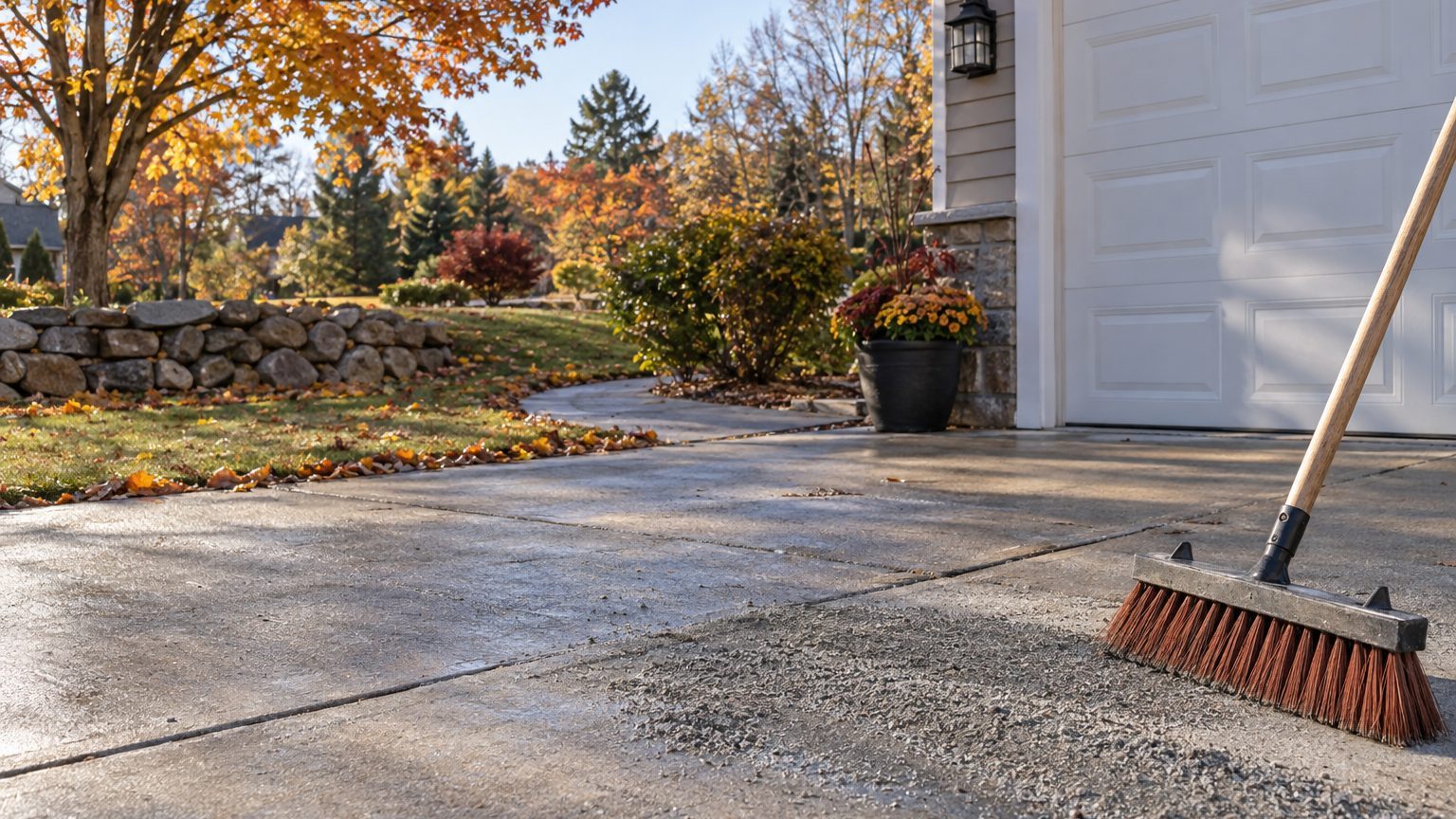

Rock salt does not dissolve a sound slab, but it does speed up scaling, the flaking of the thin finished top layer of concrete. The damage comes mostly from water. Salt brine keeps ice liquid longer, pulls more moisture into the pores, and sends the slab through extra freeze-thaw cycles. A mature, well-made driveway can take light salting for years. A young or weak one can lose its surface in a single winter.
Salt feeds the freeze-thaw cycle that peels the surface
Concrete is full of microscopic capillaries that soak up water. Water expands about 9 percent when it freezes, and in a saturated surface that pressure can exceed what the cement paste can resist. Salt makes this worse in three ways. It melts snow that would otherwise sit frozen and harmless on top. It lets brine refreeze overnight after an afternoon thaw, which adds a cycle the slab would have skipped. And salt solutions hold moisture in the surface layer longer, so the concrete stays closer to saturation.
There is also an osmotic effect. When the brine in the surface pores is saltier than the water deeper down, water migrates toward the salty side, and the resulting pressure helps delaminate the top skin. Scaling usually shows up as flat, irregular patches that expose the coarse stone underneath, and on a young or weak slab it can appear as early as the first winter of exposure.
Chloride also reaches steel. A driveway with rebar or wire mesh can rust internally, and that rust expands and cracks the slab from below. Scaling is the visible part. Corroding steel is the more serious one, and it shows up as cracks with rust stains.
New, thin or poorly drained slabs are the ones that fail
Two neighbors can spread the same product after the same storm and end up with very different driveways. The difference is usually the concrete. Slabs in freeze-thaw climates need entrained air, microscopic bubbles that give freezing water room to expand. Air content of roughly 5 to 7 percent is typical for exposed flatwork. Concrete that was finished in poor weather, overworked with the trowel, or not cured properly has a weak skin that salt will find.
Age matters most. Most guidance says to keep every chemical de-icer off a new driveway for its entire first winter. Some manufacturers and contractors push that to two or three years, and sand-only is the safest policy on a slab that young. Hydration continues for months after the pour, and the pore structure stays more open than it will later.
Location on the slab matters too. Damage starts where salt and standing water collect: the apron at the garage door, the low end of a sloped drive, the strip where road slush drips off car bodies, and the edge where plows pile salty snow. If one patch scales year after year, look at drainage before blaming the product.
Calcium and magnesium chloride are not the gentle swap their labels suggest
Many bags of “concrete-safe” or “pet-friendly” melt are calcium chloride or magnesium chloride. Both work at much lower temperatures than rock salt, which stops being useful at about 15°F. Calcium chloride keeps working to roughly minus 20°F. Neither is automatically easier on concrete.
A 2008 Iowa research report (TR-480) tested concentrated brines of magnesium chloride, calcium chloride, sodium chloride and calcium magnesium acetate. It found significant evidence that magnesium chloride and calcium chloride react chemically with hardened cement paste. The result was expansive cracking, higher permeability and a significant loss of compressive strength. Sodium chloride did not cause those chemical effects, but its brine penetrated the concrete fastest, which matters for rebar.
Other laboratory work ranks magnesium chloride as the most destructive, calcium chloride next, and sodium chloride as comparatively benign except under certain freeze-thaw conditions. In those tests, the damage rate depends on how much is applied and how often. These are lab results on concentrated solutions, and a homeowner’s driveway sees far less. Still, calcium chloride is hygroscopic, meaning it pulls moisture from the air and stays wet longer. That prolonged wetness can add freeze-thaw cycles of its own.
Chemical attack aside, one point holds for all three. They are all chloride products and all can contribute to scaling, so the amount you use matters more than the brand on the bag.
Shoveling, sand and acetate-based melts cover most needs
The gentlest approach is mechanical. Shovel or plow early, before traffic packs snow into ice, and most of the need for chemicals disappears. Coarse sand or mineral grit gives traction with no chemistry at all. It does not melt anything, and it needs sweeping in spring so it does not clog drains or get tracked indoors.
Calcium magnesium acetate (CMA) is the least aggressive chemical option. It contains no chloride and is derived from dolomitic lime and acetic acid. The tradeoffs are cost and speed: it is more expensive, works more slowly, and is practical only down to about 20°F. Potassium chloride is milder than sodium or calcium chloride but stops working below roughly 25°F. Never use ammonium nitrate or ammonium sulfate products on concrete. Both attack the cement directly.
For a small, high-use area such as a front stoop, a heated mat melts snow with no residue, provided the surface and electrical setup are compatible.
Sealing and a light hand make salting tolerable on sound concrete
A penetrating silane or siloxane sealer soaks into the surface and lines the pores with a water-repelling barrier. That cuts how much salty water gets in, which is the root of both scaling and rebar corrosion. These sealers differ from the film-forming coatings that sit on top, and they are generally applied in dry weather before winter. A new slab can be sealed once it has cured, and the first-winter no-salt rule still applies.
When ice remains on mature concrete, shovel first, then spread the smallest effective amount evenly. A common guideline is about one coffee mug of rock salt for a 20-foot driveway. Granules left over after the ice has melted mean you overdid it. More product does not melt faster beyond a certain point, and it increases the damage potential. Pre-wetting the salt helps it work with less volume.
Skip salt altogether when it is colder than about 15°F, because at that point it sits on the concrete without melting anything. Push loosened slush off the slab instead of leaving it to refreeze.
Light scaling can be cleaned and sealed to slow it down. Wider or deeper damage calls for removing the loose material and resurfacing with a polymer-modified overlay, then sealing. Scaling across more than roughly 30 to 40 percent of the surface generally means replacing the affected panels or the whole slab.
Sources : ncbi.nlm.nih.gov | publications.iowa.gov