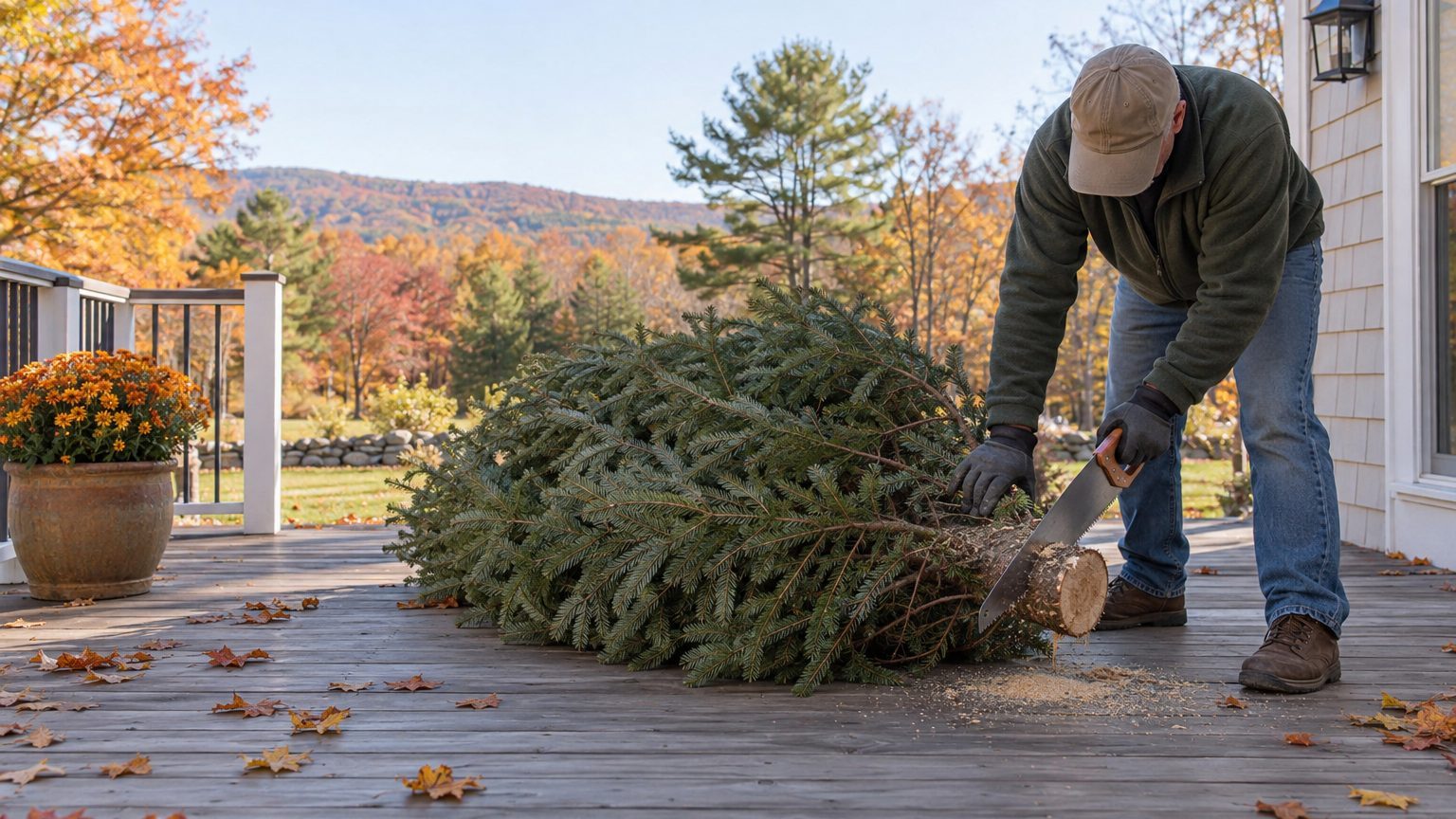

A cut tree has no roots, so the stand is its only water supply. What keeps it green into January is a fresh cut made just before setup, a reservoir that never drops below the base of the trunk, and a spot at least 3 feet from any heat source. Get those three right and a tree usually looks good for about four weeks. Skip them and it can be shedding needles in under two.
A fresh cut of 1/2 to 1 inch reopens a sealed trunk
Once a tree is cut, the trunk end starts to dry and resin clogs the tissue that carries water upward, according to Michigan State University Extension. The fix is a saw. Take 1/2 to 1 inch off the base, straight across, right before the tree goes into the stand. The National Christmas Tree Association (NCTA) says most species can go 6 to 8 hours after cutting and still take up water. A tree cut at a choose-and-cut farm and set up within a couple of hours may need little more than a stand. A lot tree that has been sitting for days needs the fresh cut.
The cut should be square, perpendicular to the trunk. An angled or V-shaped cut makes the tree harder to hold upright, and it needs deeper water to cover the whole cut surface. Drilling a hole in the base does not improve uptake. Neither does whittling the sides of the trunk to squeeze it into a small stand, because the outer layers of wood take up water most efficiently. Buy a stand that fits the trunk instead of shaving the trunk to fit the stand.
If the tree can’t go indoors right away, store it somewhere cool and sheltered, such as a garage or porch out of the wind and sun. Stand the trunk in a bucket of water. If the base dried out while the tree waited, make another cut just before it goes in the stand.
One quart of water per inch of trunk, checked every day
A fresh tree can use up to 1 quart of water a day for each inch of trunk diameter. A typical 7-foot tree with a 3-inch trunk can drink up to 3 quarts daily. Size the stand to match: the NCTA says a stand for a 4-inch trunk should hold at least a gallon with the tree in it. Water capacity is the most important feature of any stand. An undersized reservoir can empty overnight, and a trunk that is no longer submerged starts to seal over again.
The first week is the thirstiest. Check the stand twice a day for the first two days, then at least once daily. The water level has to stay above the bottom of the trunk, and that is harder to judge than it sounds. With many stands, water can remain in the bowl even though the cut end is no longer sitting in it. If the stand does run dry, refill it right away. If the tree still won’t drink, pull it out and cut another slice off the base.
Plain tap water is all the tree needs. Sugar, aspirin, bleach, soda and floral preservatives have not been shown to help, and the NCTA notes that some additives and home mixtures can increase needle loss. Water temperature doesn’t matter either. Two NCTA researchers, Gary Chastagner and Eric Hinesley, have written that it does not affect uptake, and Hinesley said in December 2024 that boiling the water first is unnecessary. A few extension and tree-association pages still recommend hot water to melt sap, but that claim has not been backed by research. A fresh cut does the real work.
A tree that seems to drink little isn’t necessarily in trouble. Uptake varies from day to day. The best test is the tree itself. Bend a few needles: if they snap instead of flexing, or if they drop when you run a hand along a branch, the tree is drying out.
Keep it 3 feet from heat, because warm rooms double as dryers
The National Fire Protection Association recommends keeping a tree at least 3 feet from any heat source, including fireplaces, radiators, heat vents and candles. Wood stoves belong on that list too, and so do television sets and sunny windows. The NCTA points out that the warmer the room and the lower its humidity, the more water the tree must take up. A tree beside a heat register may drink noticeably more than the same tree in a cooler corner, and it will shed sooner if the stand ever falls behind.
Lowering the thermostat in the tree’s room slows drying and cuts daily water use. A humidifier placed near the tree adds a local boost of moisture. Cutting the airflow also helps, so close or redirect any vent that blows toward the branches, and keep ceiling fans off.
Lights count as a heat source. Miniature lights and LEDs give off little heat and reduce drying, while older large incandescent bulbs warm the needles right around them. Don’t overload outlets, and turn the lights off when you leave the house or go to bed.
Species matter at the margins. Noble fir, Fraser fir, Nordmann fir and Scotch pine are known for holding their needles best, and Douglas fir, concolor fir and white pine hold up well with daily watering. Even the best of these becomes a fire hazard once it dries out, so take the tree down when the needles snap instead of bend.
Sources : canr.msu.edu | extension.msstate.edu