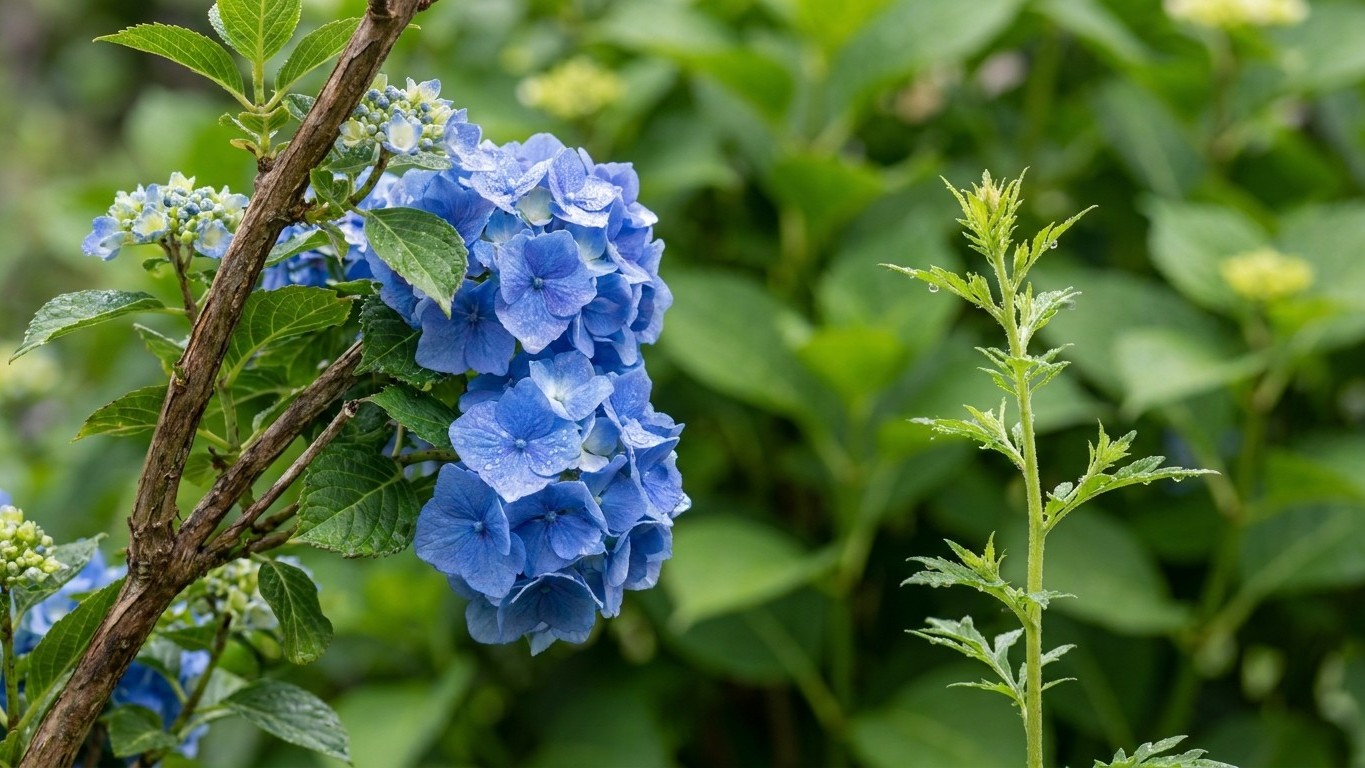

Container-grown hydrangeas can go into Nova Scotia ground from mid-May to early June, or in early September. Panicle and smooth types are the dependable choice for flowers every year. Bigleaf hydrangeas are the gamble, because their flower buds often die over winter. The timing rests on one reference point, the Halifax Stanfield airport station, where the last spring frost falls on average May 7. Coastal, valley and upland districts each shift that date, so the arithmetic is shown for you to redo. More provincial guides live in our Nova Scotia guides.
When to plant Hydrangeas in Nova Scotia

The reference city is Halifax, and the numbers come from Environment and Climate Change Canada’s Canadian Climate Normals for 1981-2010, station Halifax Stanfield Int’l A. That station shows a last spring frost on average May 7, a first fall frost on average October 18, and 163 frost-free days on average. Two cautions go with those figures. They are mean dates, so in one year out of two the last frost lands later than May 7. Treat it as the middle of a window, never a safe date. And northern or higher-elevation parts of the province run weeks behind the airport. (Canadian normals also cover 1981-2010, while the US figures elsewhere on this site cover 1991-2020, so don’t compare them digit for digit.)
Spring planting: the count-forward arithmetic
A dormant or leafed-out hydrangea in a pot is hardy; a frost won’t kill the roots. What a late frost does is blacken tender new leaves and, on bigleaf types, nip the stem tips that carry this year’s flowers. So add a cushion. May 7 plus 10 to 14 days gives May 17 to May 21 as a comfortable planting date at the reference station. Keep a bedsheet or a few upturned buckets handy for the half of years when frost runs late.
Now shift the calendar for your own spot. If your district typically gets its last frost three weeks after Halifax, the same cushion points to roughly June 7. Your local frost history, or a neighbor who has gardened there for twenty years, beats any provincial average.
Seed, cuttings and hardening off
Home gardeners almost never start hydrangeas from seed. Named cultivars don’t come true from seed, and seedlings take years to flower. The indoor-start equivalent is a rooted cutting. Softwood cuttings taken in June or July root within several weeks, and the young plants spend their first winter in pots in a cold but frost-free spot, such as an unheated garage or a sheltered cold frame.
Anything raised under cover, including garden-centre plants sold in April greenhouse conditions, needs hardening off. Count back from your planting date. To plant on May 21, begin on May 11: two hours of shade outdoors on day one, adding a couple of hours and a little sun each day, then leave the pot out overnight for the last two or three days if the forecast stays above freezing. Ten days is plenty.
Fall planting
Early fall is a good second window, since soil is warm and rain returns. Count back six weeks from the October 18 mean first frost and you land on September 6. Plants set out by then have time to root before the ground stiffens. Later than that, keep the shrub in its pot, mulch the pot heavily against a north wall, and plant in spring.
Soil and site preparation
Start with light. Morning sun and afternoon shade suits nearly every hydrangea, and it matters most for bigleaf and oakleaf types, whose leaves scorch and wilt in hot afternoons. Panicle hydrangeas take full sun if the soil stays moist, and Nova Scotia’s cooler summers make that easier than in, say, Connecticut. Avoid the low spot where cold air pools in spring, and avoid a bare, wind-scoured slope, particularly near the Atlantic, where salt spray burns foliage.
Soil should be loose, rich in organic matter and able to drain. Test drainage the month before you plant: dig a hole about a foot deep, fill it with water, let it drain, then fill it again. If water is still standing hours later, build a raised bed or choose another spot, because hydrangeas like moisture but rot in soggy ground. Heavy clay can be improved with a couple of inches of compost worked in, but don’t backfill a planting hole with rich soil alone, as roots then circle inside it.
Timing the amendments helps. Compost spread in fall settles over winter; if you’re starting in spring, work it in at least two to four weeks before planting. Send a soil sample to a lab at the same time. A test gives pH, and pH decides flower colour in bigleaf hydrangeas. Many Nova Scotia soils lean acidic, but that varies from field to field, so test rather than assume.
Spacing follows mature size, not pot size. Smooth and compact bigleaf types need roughly 3 to 4 feet between plants, while large panicle shrubs want 6 to 8 feet. Read the plant tag. Dig the hole twice as wide as the root ball and no deeper, set the crown level with the surrounding soil, firm lightly, and water in slowly.
Varieties that suit Nova Scotia
The trait that matters most is where the flower buds form. Panicle (Hydrangea paniculata) and smooth (H. arborescens) hydrangeas bloom on new wood, grown this year. Winter can kill their stems to the ground and they still flower. Bigleaf (H. macrophylla) and oakleaf (H. quercifolia) bloom mainly on old wood, formed the previous summer, so a hard winter or a late-spring frost can erase a whole season of flowers. Some bigleaf cultivars, such as Endless Summer, also bloom on new wood, which makes them a safer bet than classic mopheads, though less reliable than panicles.
Bloom time and size are the other traits worth checking. Earlier bloomers give the wood more time to harden before frost, and compact forms fit small yards and are easy to cover in winter.
| Type | Blooms on | Winter reliability | Widely sold examples and best use |
|---|---|---|---|
| Panicle | New wood | Highest | Limelight (tall, sturdy stems), Quick Fire (earlier bloom), Little Lime (compact), Tardiva (late bloom, bigger shrub) |
| Smooth | New wood | High | Annabelle (classic white, floppy in rain), Incrediball (stiffer stems) |
| Reblooming bigleaf | Old and new wood | Moderate | Endless Summer (blue or pink with soil pH), best against a sheltered wall |
| Classic bigleaf | Old wood | Low in cold districts | Mopheads and lacecaps, for sheltered coastal gardens |
| Oakleaf | Old wood | Moderate | Snow Queen, for shade and fall leaf colour |
Those names are a sample of what garden centres commonly stock. Availability changes by season and nursery. If you can only choose one, a panicle such as Limelight or a smooth like Incrediball is the lowest-risk start. For comparison with other climates, see our guides to growing hydrangeas in Minnesota, where winters are far harsher, and growing hydrangeas in Connecticut, where bigleaf types have an easier time. The broader complete hydrangea guide covers the species themselves.
What to plant alongside
The best neighbors tolerate the same shade and moisture. Hostas, ferns, astilbe, heuchera and Japanese forest grass all grow happily at a hydrangea’s feet, and their foliage shades the soil surface, which slows evaporation. That is a real benefit, not folklore. Plant spring bulbs such as daffodils in the same spot, since hydrangeas leaf out late and the bulbs finish before the shrub needs the space. Rhododendrons and azaleas share the preference for acidic, moist soil, which makes them easy partners.
Pollinator draw is real but uneven. Smooth and panicle types with a mix of fertile florets, and lacecap bigleaf types, are visited by bees and other insects. Mophead flowers are mostly sterile showy sepals and offer little. If pollinators matter to you, mix in a few Perennials that bloom at different times, such as bee balm, though keep them from crowding the shrub.
The neighbors to avoid are the thirsty ones. Large shallow-rooted trees like maples and birches steal water, and lawn grass pressed to the stem competes for water and nitrogen, so leave a mulched ring. Crowding hydrangeas against mildew-prone perennials raises humidity and cuts airflow, so give each plant elbow room.
Some claims have no evidence behind them. Marigolds or garlic planted nearby do not reliably deter hydrangea pests. Coffee grounds, rusty nails and pennies do not turn flowers blue. Aluminum availability in acidic soil does that, and a soil test tells you where you stand.
Watering, feeding and support
Hydrangea means “water vessel,” and the leaves show it fast. Aim for about an inch of water a week, rain included, delivered deeply at the base rather than in daily sprinkles, which encourage shallow roots. In the first season, check new plantings every few days in dry weather and soak the root zone until water penetrates several inches. Midday wilting on a hot day that recovers by evening is normal. Wilting that persists in the morning means check the soil.
Mulch with 2 to 3 inches of shredded bark or leaf mold, pulled back a few inches from the stems so the crown doesn’t stay wet. Mulch holds moisture, keeps roots cooler, and in fall helps insulate against freeze-thaw swings.
Feeding is simple. Apply a balanced, slow-release fertilizer once in spring after growth starts, and stop by midsummer. Late nitrogen pushes soft growth that frost will kill, and it can come at the expense of flowers. Compost each spring may be all an established shrub needs.
Support and pruning
Annabelle and other smooth types often flop under the weight of wet blooms. A peony ring or grow-through grid set early in spring lets stems grow through it, which looks tidier than staking after they fall. Panicle stems are usually stiff enough alone, though a heavy rain on a young Limelight can bend it.
Prune panicle and smooth hydrangeas in late winter or early spring, before growth starts, since they flower on new wood. Smooth types can be cut back hard. Prune bigleaf and oakleaf types lightly, right after flowering, and remove only dead stems in spring, once you can see which buds survived. Hydrangeas sucker modestly. Dig out unwanted shoots in spring, or lift and replant them as new plants.
Common problems

Reading the symptoms
No flowers on a healthy plant is the most common complaint, and in Nova Scotia the usual culprit is winter or frost damage to bigleaf buds. Other causes are pruning bigleaf in fall or early spring, too much shade, and heavy nitrogen feeding, which grows leaves at the expense of blooms. Check for green buds on the stems in spring. If the stems are bare and brittle, wait until leaves emerge before cutting.
Wilting has three common causes: heat, dry soil, and the reverse, saturated soil that has suffocated roots. Push a finger several inches into the soil before you water. Brown crisp leaf edges point to afternoon sun, drought, or salt spray near the coast. White powdery coating is powdery mildew, which tends to show up in crowded, shaded plantings with poor airflow. Thin the neighbors and avoid wetting foliage. Small dark leaf spots are fungal leaf spots, mostly cosmetic. Rake up fallen leaves in autumn and water at the base.
Blue or pink flowers on bigleaf plants are soil chemistry rather than a problem. Blue needs acidic soil, roughly pH 5.2 to 5.5, and pink needs roughly 6.0 to 6.2. White hydrangeas don’t change.
Pests
No Canadian province publishes a home-garden pest list of its own, so the best documented list for the region is from the neighbouring US state of Maine. University of Maine Cooperative Extension names browntail moth, winter moth, cabbage maggot, Colorado potato beetle, emerald ash borer, lily leaf beetle, seedcorn maggot, spotted wing drosophila, squash vine borer and striped cucumber beetle as top pests. The biology crosses the border, though the calendar does not always. That doesn’t mean any of them are absent from Nova Scotia, or that they all matter to hydrangeas.
Most on that list attack vegetables, lilies or ash trees. Browntail moth and winter moth are caterpillars that defoliate a wide range of deciduous trees and shrubs, so watch for chewed foliage and webbed nests in spring. Browntail caterpillar hairs can cause a skin rash, so don’t handle the nests bare-handed. Deer are the other regular browser of hydrangeas. For identification, take a sample to your Nova Scotia Department of Agriculture contact.
Does the Season Leave Time for Bloom and Hardening?
The question is whether the shrub has time to bloom and to harden its stems before hard cold. At the Halifax reference station, 163 frost-free days on average separate the last spring frost from the first fall frost, and May 7 to October 18 is about 164 days by the calendar. Subtract your planting delay: a shrub set out May 21 has about 150 days left.
Next subtract bloom lead time. Panicle and smooth types typically open in July and August in cool climates. A cultivar opening July 15 leaves roughly 13 weeks before October 18. A late bloomer opening in early September leaves about six. Late-opening blooms still finish fine, since the flowers tolerate cool nights, but late-blooming types give stems less time to harden. A working target is eight to ten weeks between first open bloom and first fall frost.
Redo it for your own district. Take your local first fall frost date minus your planting date, then subtract the cultivar’s bloom lead time. An upland garden with a last frost near May 28 and a first fall frost near October 1 has 126 frost-free days. Planted on June 7, it keeps 116 days to October 1. Choose early bloomers there, and pass on Tardiva.
What buys extra weeks: a larger pot size at planting, a south or west wall for shelter, frost cover on the shoulder nights at both ends, and no fertilizer after July. Black plastic around a shrub blocks water and air, so use mulch instead.
Cut Flowers and End of Season
For cut flowers, harvest in the morning once the blooms feel slightly papery, then place stems in water immediately. For dried arrangements, cut late in the season when florets begin to shift colour, strip the leaves, and stand the stems in an inch of water. Let the water evaporate, and the heads will dry in place. Panicle and smooth heads left on the plant make attractive winter structure and a little extra insulation, so you don’t need to deadhead in fall.
Winter protection
Stop feeding by midsummer, and in the weeks before the mean first frost of October 18 (a midpoint, so it can arrive earlier), keep watering if the weather turns dry. Leave bigleaf hydrangeas unpruned. After the ground cools, add 3 to 4 inches of mulch or leaves over the root zone. For bigleaf types in exposed gardens, a wire cage filled loosely with oak leaves, or burlap on stakes to block drying wind, protects the buds that carry next year’s flowers. Salt-laden coastal wind is the added hazard on the Atlantic side, so shelter, not just warmth, is the goal. Pull the cage in spring once the forecast clears, but later than feels necessary.
Local help
Provincial dates and conditions vary a lot between the Annapolis Valley, the South Shore, Cape Breton and the uplands. The Nova Scotia Department of Agriculture is the place to ask for district-level frost timing, soil testing options and pest identification. Bring a photo or a bagged sample, and ask about lab pH tests before you amend.
Common questions
Can I plant hydrangeas in Nova Scotia in the fall?
Yes, if they go in with roughly six weeks to spare before the ground freezes. Counting back from the October 18 Halifax mean first frost points to about September 6. Water through dry spells and mulch after the ground cools.
Which hydrangea is safest for a cold or exposed garden?
Panicle and smooth types, because they flower on new wood. Limelight, Quick Fire, Annabelle and Incrediball are widely sold examples. Even if winter kills the stems back, the plant still blooms that year.
Why won’t my bigleaf hydrangea bloom?
Most often the flower buds were killed by winter cold or a late frost, or the shrub was pruned at the wrong time. Too much shade or too much nitrogen can also cause it. Wait for leaves before cutting stems in spring.
Can I change flower colour in Nova Scotia?
Only on bigleaf hydrangeas. Acidic soil, roughly pH 5.2 to 5.5, gives blue, and roughly 6.0 to 6.2 gives pink. Get a lab soil test first, and adjust slowly. White hydrangeas don’t change.
Do hydrangeas need winter protection here?
Panicle and smooth types seldom do beyond mulch. Bigleaf and oakleaf types benefit from mulch plus a leaf-filled cage or burlap screen, especially on exposed or coastal sites. Salt spray and drying wind do as much harm as the cold itself.