
When it’s 20 to 40°F outside, indoor relative humidity (the share of moisture the air holds compared with the most it could hold at that temperature) can run up to 40% in a house heated to 70°F. The ceiling then drops about 5 points for every 10°F of cooling. The Fenestration and Glazing Industry Alliance (FGIA) publishes the chart most others copy. It allows 35% at 10 to 20°F, 30% at 0 to 10°F, 25% at -10 to 0°F, 20% at -20 to -10°F, and 15% below -20°F.
Treat those numbers as maximums. Showers, cooking, and overnight breathing add moisture on top of whatever your humidifier does, and every person sleeping in a bedroom puts roughly a liter of water into the air by morning. If your house sits a few points under the ceiling, you have margin. If it sits at the ceiling, the first cold snap tips it over.
The Ceiling Drops With the Thermometer
The EPA’s range of 30 to 50% relative humidity, kept below 60%, is built around mold. It isn’t built around clear glass. In winter, the cold surfaces in your house cross the dew point (the temperature where air can no longer hold its moisture) long before the room air gets anywhere near 60%. That’s why cold-climate guidance leans toward 30 to 40% and slides lower as the forecast does.
Here’s how the bands play out on a typical January. A mild stretch in the 30s lets you hold 40%. A week of highs in the teens and lows near 5°F calls for 30 to 35%. A true deep freeze, the kind that hits northern New England and the Appalachian high country a few nights a year, puts the ceiling at 20 to 25%. A university extension table for homes with double windows lands in the same place: 35 to 40% at 20°F, 25 to 30% at 0°F, and 15 to 20% at -20°F.
Some guidance gives more room in mild weather. A few building-science references allow 45% above 40°F outside, and one allows 45 to 50% above 35°F. That works in a tight, well-glazed house. In an older one, stay at 40%.
Why Your Windows Set the Limit
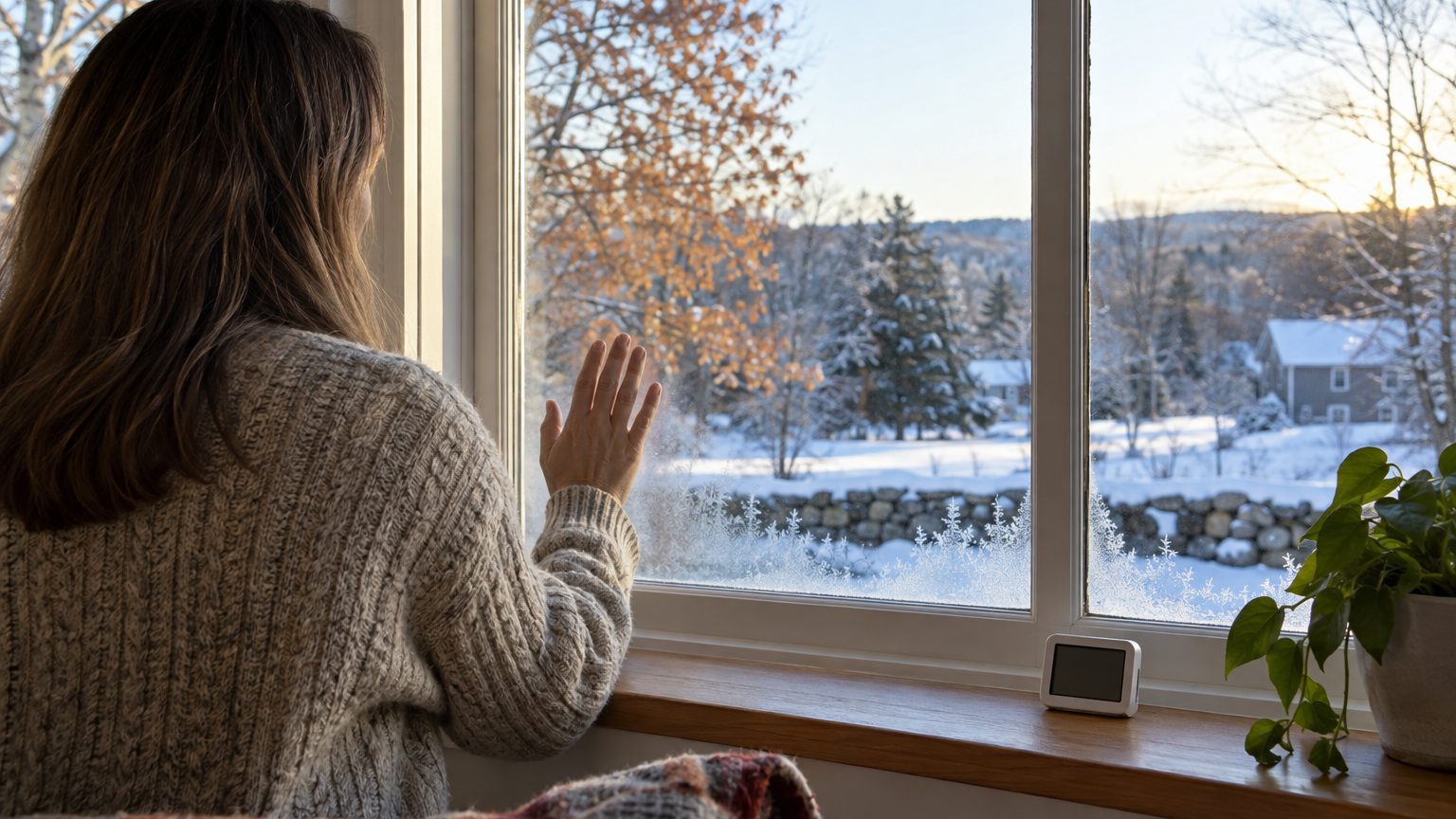
The inside surface of a window is the coldest thing in most rooms. Warm, moist air touches it, drops below its dew point, and leaves water on the glass. Over a winter that water runs onto the sill and frame, where it feeds mold and rot. Air at 50% in the middle of the room can condense the instant it reaches a pane that’s 30 or 40°F.
Glazing changes the numbers more than anything else. At 0°F outside, single-pane glass pulls the safe indoor ceiling down to roughly 10%. Standard double-pane allows about 30%, low-e double-pane about 40%, and triple-pane about 45%. Same weather, four very different limits. So the FGIA chart, which assumes ordinary double-pane windows, runs too high for a farmhouse with original sash and too low for a newer triple-pane build.
Your own glass is the best gauge. Clear windows in the morning mean you’re under the ceiling. A fogged corner or a line of frost along the bottom edge means you’re over it. Drop the humidifier setting 5 points and check again the next morning. Wipe the sills dry in the meantime, because the EPA advises drying wet materials within 24 to 48 hours before mold gets a foothold.
Condensation doesn’t always point to a bad window. FGIA notes that fog on the room side of the glass reflects indoor conditions and doesn’t mean the unit has failed. Fog that won’t wipe off, because it sits between the panes, is a different problem and signals a failed seal.
The Dry-Air Floor and Setting a Humidifier
Furnaces and heat pumps add heat but no moisture, so winter air gets very dry once it’s warmed. A university extension specialist reports that 0°F outdoor air heated to 70°F falls to about 5% relative humidity. The same math gives roughly 14% from 20°F air and about 34% from 40°F air. Leaky houses pull that dry air in constantly, and many heated homes end up at 15 to 25% from December through February unless something adds moisture.
Below about 30%, static shocks, nosebleeds, dry sinuses, and gaps opening in wood floors and furniture joints become common. On the coldest nights the condensation ceiling and the dry-air floor can sit only a few points apart. A comfortable target on a 5°F night is 25 to 30%, and that will feel dry compared with a 45% summer day. Expect it. The alternative is water pouring down the glass.
Tight, newer houses often hold above 30% with no help from a humidifier, so measure first. The EPA notes that a humidity meter is a small, inexpensive instrument (about $10 to $50) sold at many hardware stores. Put one in the room where you spend the most time and a second in the coldest bedroom, since readings can differ by several points between floors. Basements and bathrooms often run much higher than the rest of the house.
Humidifier dials are rarely accurate, so set the machine by the meter’s reading. A practical routine is to start at 40% when the forecast low is above 20°F, then lower the setting 5 points for each 10°F drop below that. Run the bathroom and kitchen fans during showers and cooking, and vent the dryer outdoors. If you humidify a nursery, use a cool-mist unit, because steam vaporizers can cause burns from spilled hot water. For kids’ rooms, keeping the same 30 to 40% as the rest of the house is fine.
Hygrometers drift, and cheap ones can be several points off. You can check yours by sealing it in a zip-top bag for 8 to 12 hours with a small dish of damp table salt. It should read 75%, and any gap between that and the display is the correction to apply to every reading afterward.
Source : epa.gov