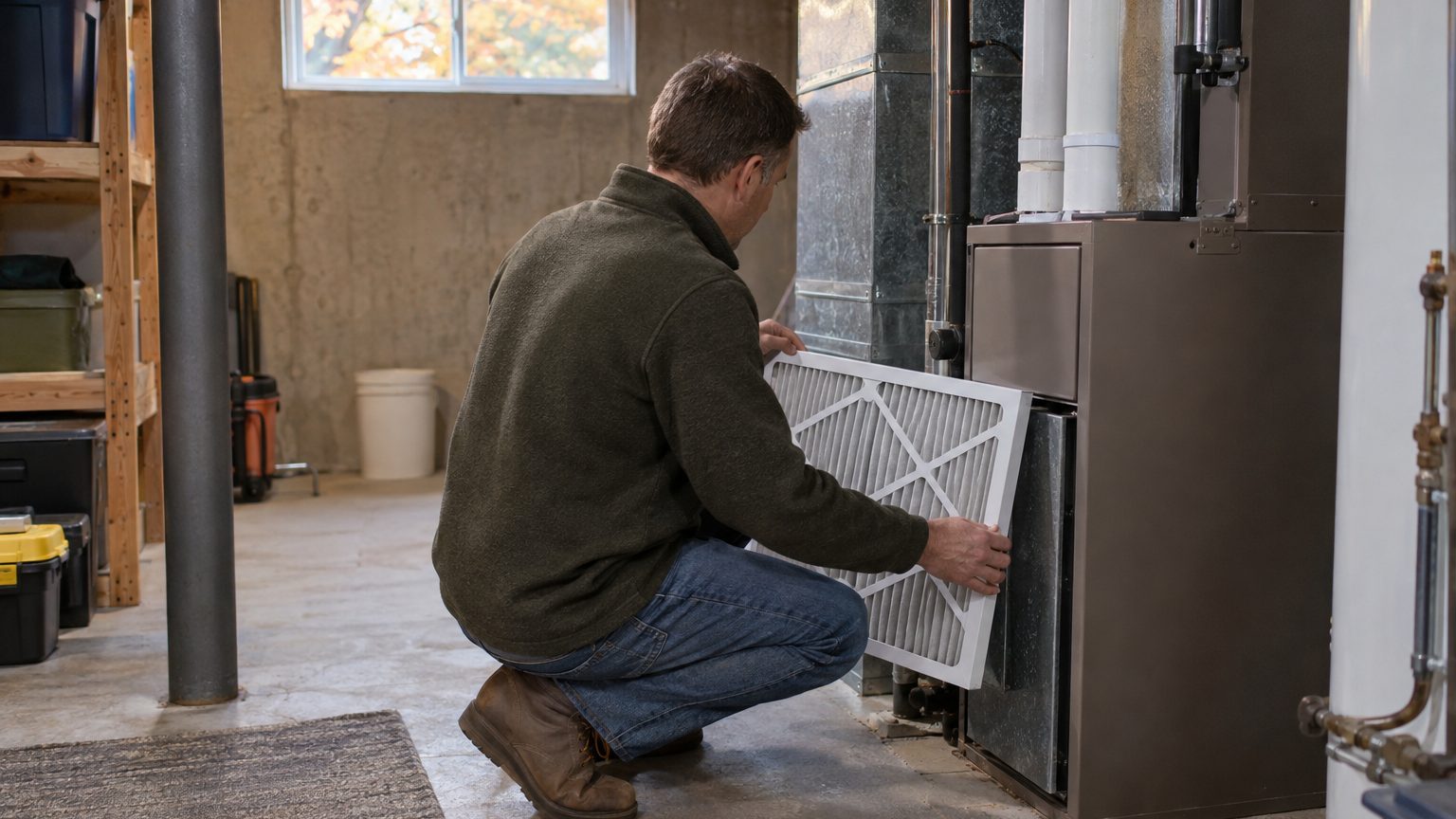

The arrow on the edge of a furnace filter points in the direction the air is traveling. That’s it. Air should flow the way the arrow points, which means the arrow always aims toward the blower motor and away from the return duct where the air comes from.
Getting it backward won’t wreck your furnace overnight. But a filter installed in reverse can shed debris, load up unevenly, and let the frame collapse under suction, and most homeowners never notice until the system is struggling.
Why the arrow exists at all
Most pleated filters are built in layers. A wire or cardboard backing sits on the downstream side to hold the media in shape, while the loosely woven, coarser layer faces the incoming air to catch big particles first.
Flip it, and the fine media takes the full force of the airflow without that support. Pleats can bow, separate from the frame, or flatten, which opens gaps that let dust bypass the filter and settle on the blower wheel and evaporator coil.
Fiberglass disposables, the thin blue or pink ones, are more forgiving, but they carry an arrow too. Follow it anyway.
Pressure drop matters here as well. A filter loaded backward can restrict airflow more than the same filter installed correctly, and restricted airflow is a leading reason furnaces overheat and trip their high-limit switch.
Upflow and downflow furnaces
Start by figuring out which type you have. An upflow furnace pulls return air in at the bottom and pushes heated air out the top, which is common in basements and utility closets. A downflow (or counterflow) unit does the opposite, sending air down through the bottom, and you’ll often find it in a first-floor closet or attic with ductwork running through a slab or crawlspace.
On an upflow furnace, the filter usually sits in a slot at the bottom, or in the return duct just below the unit. The arrow points up, toward the furnace cabinet and blower.
Downflow setups usually hold the filter at the top of the furnace or in a return plenum above it. Here the arrow points down, again toward the blower.
Same rule, opposite direction. That’s why a filter that worked in your last house may need flipping in the next one.
If you can’t tell which way air moves, hold a tissue near the return opening while the system runs. It’ll be pulled toward the opening, and the path from there to the furnace is where the arrow should point.
Horizontal furnaces and the return grille
Horizontal units lie on their side, typically in attics and crawlspaces, and air moves left to right or right to left. The filter slot is at the return end of the cabinet or in a nearby duct. Point the arrow toward the furnace, which is the direction of travel.
Check the cabinet itself. Many manufacturers stamp an airflow arrow on the casing or the blower door, and that stamp beats any guesswork.
Return-grille filters are the setup most homes in warmer states use, especially in Texas, Florida and Arizona where the air handler sits in a closet or attic. These filters slide into a large wall or ceiling grille, and the air handler is somewhere behind it.
The arrow points away from the room and into the wall or ceiling. Think of it as pointing at the duct, since that’s where the air is headed.
A common mistake is pointing the arrow toward the room because it “looks right” when you’re standing there. Don’t.
Some homes have more than one return grille, and each can hold a filter. If your system has a filter at the furnace and another at the grille, both need the arrow pointing downstream, and the grille filters are often thinner at around 1 inch.
Sizing, timing and common mix-ups
The arrow only helps if the filter fits. Read the nominal size printed on the old filter’s frame, such as 16x25x1, and buy the same one. Actual dimensions run a fraction of an inch smaller than nominal, which is normal, but a filter that leaves a visible gap lets air slip around the edges.
Depth matters too. A 4- or 5-inch media cabinet filter lasts much longer than a 1-inch one, often six to twelve months compared with one to three, but it only fits in a cabinet built for it. Jamming a thick filter into a thin slot isn’t an option, and forcing a thin one into a deep slot invites bypass.
Before you swap, turn the system off at the thermostat. It’s a small step, but it keeps the blower from pulling loose dust into the ductwork while the slot is open.
A few habits make the job foolproof:
- Write the install date and airflow direction on the filter frame with a marker.
- Snap a photo of the old filter in place before you pull it out.
- Put a reminder on your phone for the next change.
Higher MERV ratings catch smaller particles, but they also resist airflow more. Many residential systems are designed around filters in the MERV 8 to 11 range, and jumping to a dense MERV 13 without checking the furnace manual can strain a blower not built for it. If you have allergies and want a higher rating, ask an HVAC tech whether your system can handle it.
What if you already installed one backward? Pull it out and look. If the pleats are intact and the frame is straight, flip it and reinstall. If the media looks crushed, torn or separated from the frame, toss it and put in a new one, since a few dollars beats a clogged coil.
One last check worth knowing: some filters have no arrow at all, usually the flat panel style, and a few newer designs are built to work in either direction. The packaging will say so, and if it doesn’t, treat the filter as directional and orient it by the label on the frame.