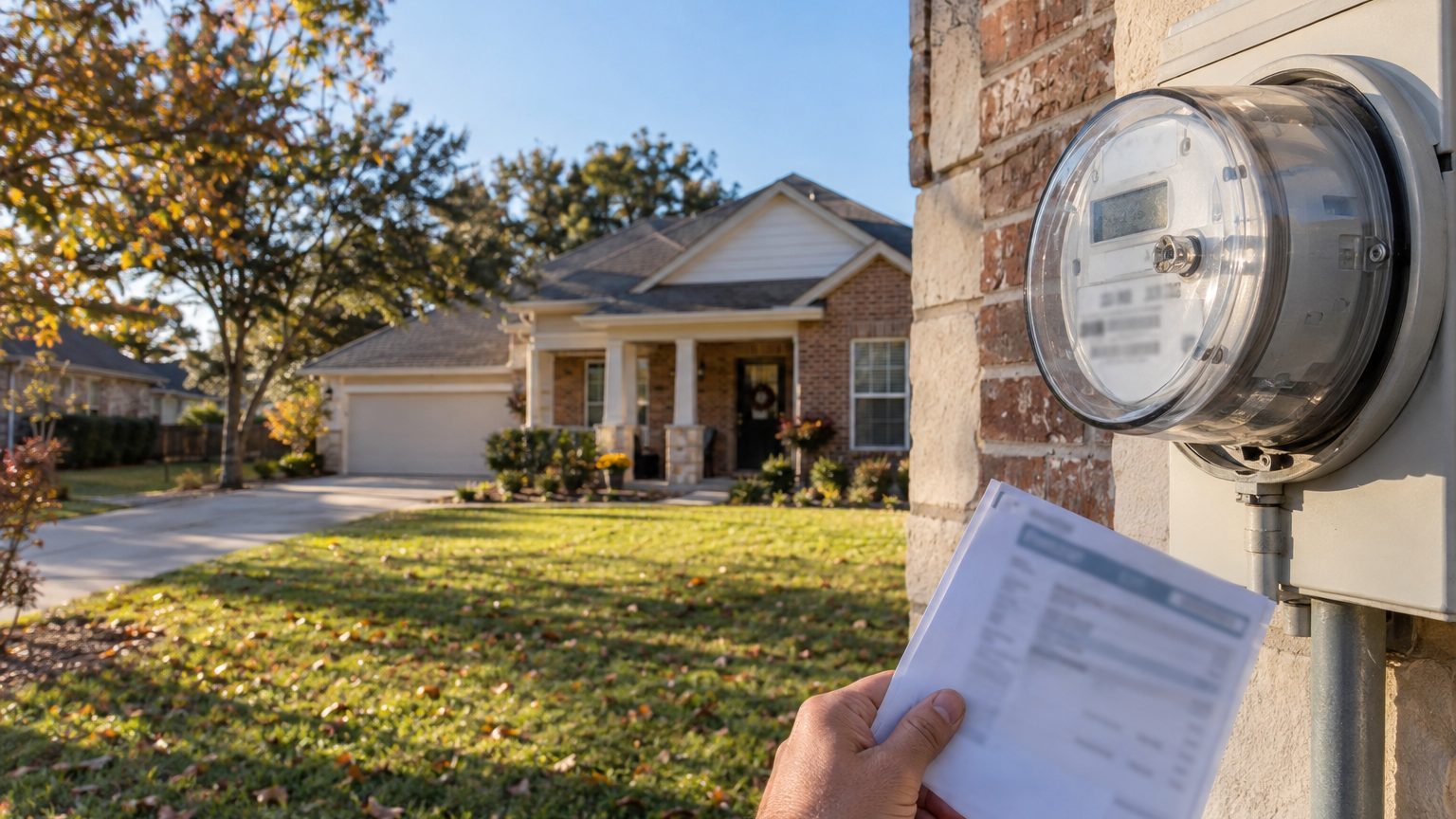

Arizona households paid an average of $160.24 a month for electricity in 2024, against $142.26 for the country as a whole. That is a statewide figure covering every utility and the whole year, so an individual home lands above or below it depending on size, equipment and season. Usage and price multiply to make the bill, and they pull in opposite directions here.
The average electric bill in Arizona
The average Arizona residential customer used 1,075 kWh a month in 2024 at 14.91 cents per kWh, according to the U.S. Energy Information Administration’s 2024 Average Monthly Bill – Residential (Table 5A, forms EIA-861). The U.S. average that year was 863 kWh at 16.48 cents per kWh. Ranked on the average bill among the 50 states and the District of Columbia, Arizona is 9th highest (43rd lowest).
The table shows how Arizona differed from the U.S. average on each measure that year.
| Measure | Arizona vs. U.S. average, 2024 |
|---|---|
| Electricity used per month | +212 kWh |
| Price per kWh | -1.57 cents |
| Average monthly bill | +$17.97 |
The EIA figure rests on 3,134,733 residential customers. It averages every month of the year and every utility serving the state, which makes it a benchmark for comparing states. It does not describe what any one household pays. A small apartment and a large house with a pool sit far apart, and so do a January bill and an August bill for the same address.
To use the number on your own account, compare it with your own monthly kWh, which sits on your statement next to the price per kWh. If your usage is near 1,075 kWh and you pay about 14.91 cents, your bill will look like the state average. If your usage is far from that, the average tells you little about your house.
Why homes here pay what they pay
The bill is usage times price, and in Arizona usage is what pushes it up. The average home used 212 kWh a month more than the U.S. average in 2024. The price ran 1.57 cents per kWh below the U.S. average, which holds the bill down somewhat but does not cancel the extra consumption. The result is a bill $17.97 above the national figure.
Heating equipment adds a second layer. According to the U.S. Energy Information Administration’s Residential Energy Consumption Survey (RECS) 2020 state tables, 55% of Arizona homes use a furnace as main heating equipment and 25% use a central heat pump. By fuel, electricity is the main heating fuel in 51% of homes, natural gas in 36% and propane in 2%. RECS publishes no figure for steam or hot-water boilers or for fuel oil or kerosene in Arizona, because those estimates were suppressed as unreliable. That is different from saying no home uses them.
These shares matter for the bill because a home that heats with electricity carries its heating on the same meter as everything else. Its winter bills rise, while a home that heats with natural gas or propane sees much of its heating cost on a separate gas or propane bill. A home that heats with gas can therefore have a lower electric bill than the state average and still spend a lot to stay warm.
RECS reports state shares from a national survey, not a count for your county, and the shares describe what homes use today. They are not a recommendation for any one fuel.
Winter and summer months
Degree days put a number on how much a climate asks of a house. NOAA NCEI’s U.S. Climate Normals for 1991-2020 list about 874 heating degree days a year (base 65 F) and about 4,765 cooling degree days at Phoenix Sky Harbor International Airport. A heating degree day counts how far the day’s mean temperature sat below 65 F, and a cooling degree day counts how far it sat above 65 F.
At the Phoenix reference station, cooling degree days far outnumber heating ones. In a climate like that of Phoenix, the highest electric bills are the summer ones, and the 2024 yearly average of $160.24 sits below what those months bring. For the same reason, a winter month usually comes in under the average for a home that does not heat with electricity.
Electric heating changes that picture. A home whose main heat runs on electricity, which describes just over half of Arizona homes in RECS 2020, adds a winter rise on top of its summer peak. A heat pump counts as electric heating, and so does an electric furnace.
The degree-day figures come from one station in the Phoenix area. A mountain county in the same state can run far colder, which means more heating degree days there and a winter load that weighs more on the bill. County extension offices and local utilities can say what the cold season looks like where you live.
What lowers the bill
A few levers are well documented, and each one acts on usage, which is the side of the bill Arizona homes can change. Settling on a thermostat setting that matches how you live is the first, and the question of whether turning the thermostat down really saves money gets a full answer with the numbers. Air leaks come next, and How to Find the Air Leaks in Your House covers how to locate them. Weatherstripping and Caulk covers closing the gaps around doors and windows once you have found them.
Insulation works on the same problem from the attic and walls, and the Home Insulation pages explain what to add and where. Central heat pumps already serve a share of Arizona homes for heating, and replacing aging heating equipment is a question to price with local quotes. More on heating and insulation in the state is in the Arizona guides.
Whatever you change, track your monthly kWh on the statement rather than the dollar total alone. The state average of 1,075 kWh in 2024 gives you a usage benchmark to measure against.
Common questions
Is $160.24 what I should expect to pay in Arizona?
No. It is the 2024 average across all residential customers and all utilities in the state, averaged over the full year. Your bill depends on your home’s size, equipment, number of occupants and the month.
Does Arizona have high electricity prices?
The price per kWh in 2024 was below the U.S. average. The bill ran above the U.S. average because Arizona homes used more electricity per month, and the state ranks 9th highest on the average bill.
Do most Arizona homes heat with electricity?
Electricity is the main heating fuel in more homes than any other fuel in RECS 2020, ahead of natural gas. Homes that heat with electricity see a winter rise in their electric bills.
Do the Phoenix degree-day numbers apply across the whole state?
They describe one station, Phoenix Sky Harbor. A mountain county can run far colder, with more heating degree days and a heavier winter load.