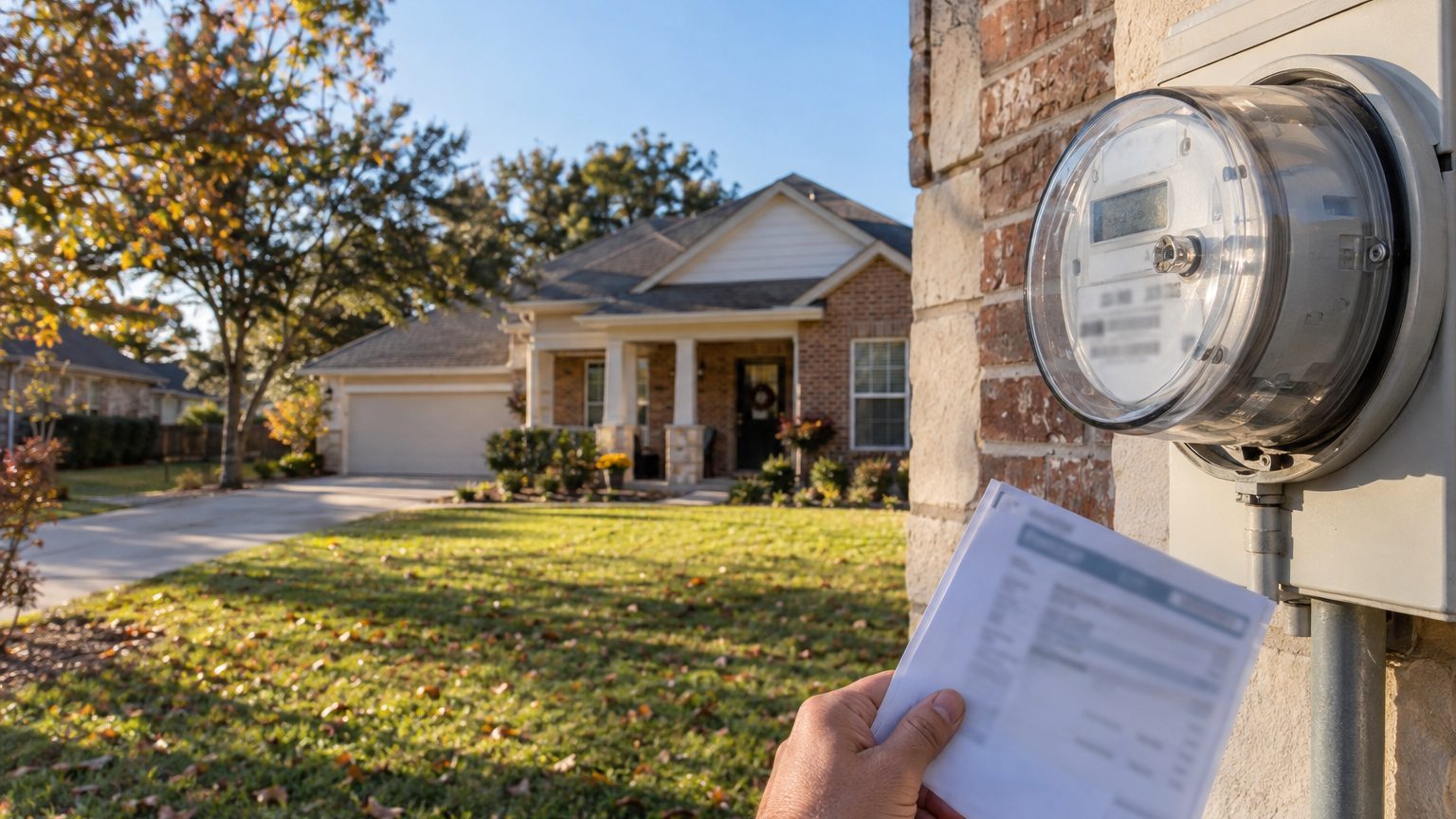

A Delaware household’s electric bill ran above the national average in 2024. Most of the gap comes from how many kilowatt-hours homes use, because the price per kilowatt-hour is barely different. Your heating equipment and the time of year then decide whether your own bill lands above or below the statewide number.
The average electric bill in Delaware
In 2024, the average residential electricity customer in Delaware used 911 kWh a month at 16.57 cents per kWh, for an average monthly bill of $150.87, according to the U.S. Energy Information Administration (Table 5A, built from its EIA-861 utility reports). The U.S. average that year was 863 kWh at 16.48 cents, for $142.26 a month.
Ranked on the average bill among the 50 states and the District of Columbia, Delaware is 14th highest, which is 38th lowest. The Delaware bill sits $8.61 a month above the U.S. average. The figure covers 473,508 residential customers.
It is a statewide average over the whole year, with every utility counted together. It is not your bill. A single winter or summer month can come in far above it or well below it, depending on how your home heats and cools.
A kilowatt-hour (kWh) is the unit your meter counts: a 1,000-watt appliance running for one hour uses one. Your statement lists the kWh you used and the price per kWh. Set your monthly kWh beside 911 first, since usage explains more of Delaware’s gap than price does.
Why homes here pay what they pay
A bill is mostly the energy used multiplied by the price paid for it, and in Delaware only one of those two runs high. The price per kWh is 0.09 cents above the U.S. figure, which is close to level. Delaware homes use 48 kWh a month more than the U.S. average, so usage does the pulling.
The Residential Energy Consumption Survey (RECS) 2020, run by the U.S. Energy Information Administration, gives state shares for main heating equipment and fuel. A furnace is the main equipment in 62% of Delaware homes, and a central heat pump in 20%. By fuel, natural gas heats 41% of homes, electricity 40%, propane 9% and fuel oil or kerosene 8%.
Those shares matter because heat that runs on electricity lands on the electric bill. A home that heats with electricity sees winter bills well above the yearly average. A home heated with natural gas, propane or fuel oil buys that heat elsewhere, so its electric bill stays closer to the average through the cold months.
The shares come from a national survey and describe the state as a whole. They say nothing about your street or county, and your own equipment is what sets your pattern. Check the nameplate on the furnace or air handler, or the fuel deliveries and gas bills, to see which group you fall in.
Winter and summer months
At Wilmington (New Castle County Airport), NOAA NCEI’s U.S. Climate Normals for 1991-2020 show about 4,647 heating degree days a year (base 65 F) and about 1,228 cooling degree days. A heating degree day adds up how far a day’s mean temperature sat below 65 F. A cooling degree day does the same for days above it.
Heating degree days far outnumber cooling degree days, so winter is the heavier season here. For a home that heats with electricity, the highest bills of the year will almost certainly fall in the cold months. For a home heated with gas, propane or oil, the winter electric bill is flatter. The warm-season months, which the 1,228 cooling degree days measure, are the other stretch to look at on your statements.
Those degree-day totals come from a single reference station. Your town may run a little warmer or colder, and the county extension office can tell you how your area compares.
To see where you stand, pull the last 12 statements and find the two highest months. If both fall in the same season, that season is where your usage is concentrated, and the changes below should start there.
What lowers the bill
Four levers cover most of what a homeowner can change, and each has its own walk-through.
- Thermostat setback. Does Turning the Thermostat Down Really Save Money weighs what a lower setting does in the heating season.
- Air leaks: How to Find the Air Leaks in Your House shows how to locate them, and Weatherstripping and Caulk covers sealing them around doors and windows.
- Insulation: the Home Insulation section covers where it goes and how much a home needs.
- Heat pump: about one Delaware home in five already heats with a central heat pump. Whether switching suits another house depends on what it heats with now.
All four act on winter use, the heavier season by degree days. State-specific questions about local utilities, programs and climate are collected in the Delaware guides.
Common questions
- Will my bill match the Delaware average?
- Rarely. The average is a yearly, statewide figure for 2024, and any single month can sit well above or below it depending on how your home heats and cools.
- Does the average include every utility in the state?
- Yes. It pools all residential customers across all utilities, so a given utility’s customers may average slightly more or less.
- What does a heating degree day measure?
- It adds up, for every day of the year, how far the mean temperature sat below 65 F. More degree days mean a longer or colder heating season and more fuel for the same house.
- Can I compare a bill from another year to the 2024 average?
- Only loosely. The figure describes 2024, and bills from other years or single months are not comparable cent for cent.