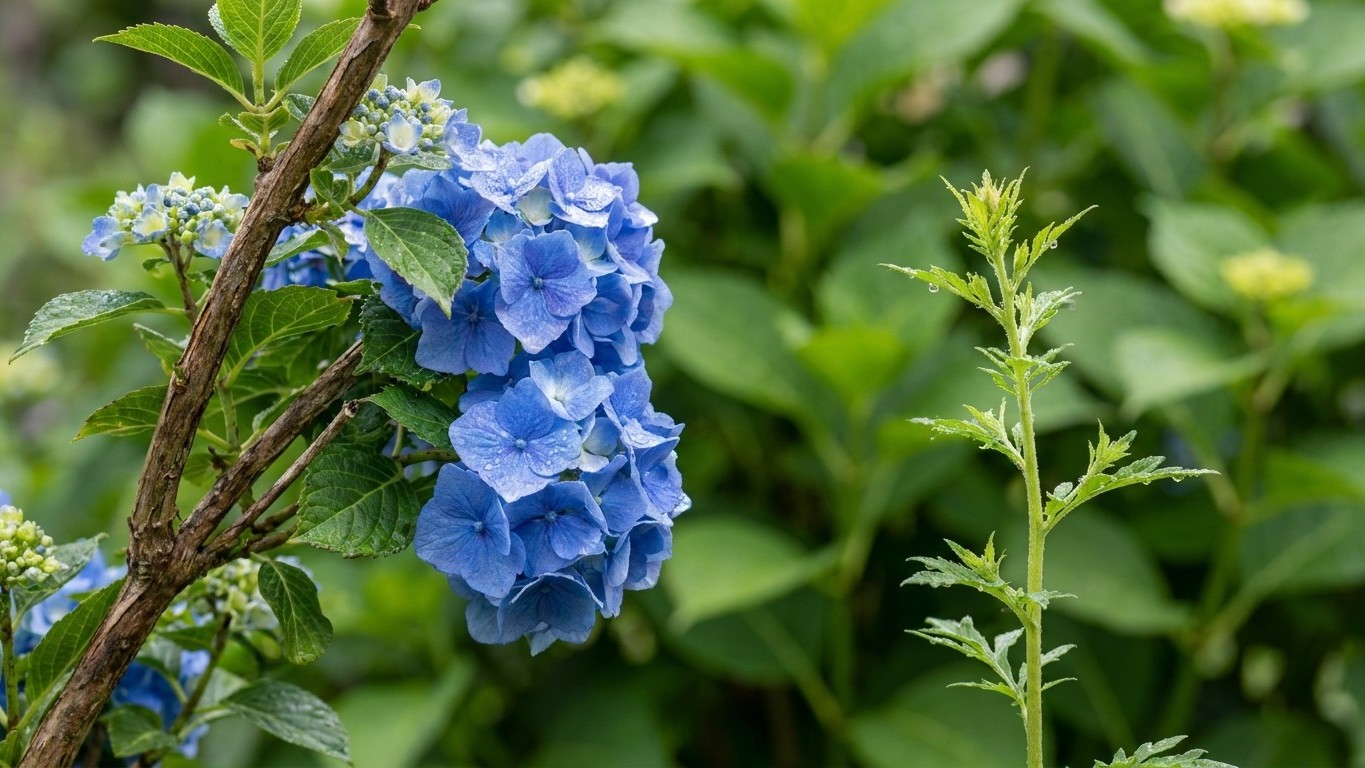

Hydrangeas grow well across much of Quebec, and the type you buy matters more than the planting date. Around Montreal, container shrubs go in from late April through May, with tender nursery plants held until mid-May or later because the average last frost is May 6. Panicle and smooth hydrangeas bloom on new wood and handle hard winters. Bigleaf types can lose their flower buds to cold. Flower color only shifts on bigleaf plants, and only with soil acidity. For species basics, see How to Grow Hydrangeas: The Complete Guide.
When to plant Hydrangeas in Quebec

The reference point here is the Saint-Hubert station near Montreal. Environment and Climate Change Canada’s 1981-2010 climate normals put the average last spring frost at May 6 and the average first fall frost at October 5, with about 150 frost-free days between them. Those are mean dates, not safe ones. In one year out of two, the last frost falls after May 6. Treat the date as the middle of a window that runs a couple of weeks either side. Canadian normals cover 1981-2010, while the US frost dates quoted elsewhere cover 1991-2020, so the two sets of numbers should not be compared directly.
A province is not one climate. Districts north of Montreal and higher ground run weeks behind Saint-Hubert, and the shift can be large enough to move a planting date from mid-May to early June. Your provincial agriculture office or a neighbor with a long-established garden will tell you more than any regional average.
Hydrangeas are more forgiving than vegetables. A dormant, leafless container shrub tolerates cold soil and can go in as soon as the ground thaws and drains, often in late April. Once leaves have opened, the soft new growth burns in a late frost, and bigleaf types are the most vulnerable. Plants that arrive already leafed out from a greenhouse should wait until roughly two weeks after the average last frost, which here means about May 20, and keep a bedsheet or frost cloth within reach through the end of the month.
Seeds, cuttings and hardening off
Starting hydrangeas from seed is rarely worth the trouble. Named varieties do not come true from seed, and seedlings need several years to flower. Softwood cuttings are the practical route for home propagation. Snip 4- to 6-inch tips in June or early July, strip the lower leaves, and root them in a moist, well-drained mix, which usually takes a few weeks. Pot the rooted cuttings up by August and keep them somewhere bright, cool and frost-free through winter.
The count-back arithmetic works from the planting date you want. To set plants out on May 20, begin hardening off 7 to 10 days earlier, around May 10. Start with two hours of shade outdoors, add an hour or two of morning sun each day, and leave them out overnight only for the last two or three days. For a district that runs three weeks behind Saint-Hubert, move every one of those dates three weeks later. A plant moved straight from a windowsill to full sun can scorch in a single afternoon.
Soil and site preparation
Light, drainage and texture
Most hydrangeas want morning sun and afternoon shade. Bigleaf and oakleaf types wilt and scorch in strong afternoon light, while panicle hydrangeas tolerate full sun as long as the soil stays evenly moist. A site on the east side of a house or under high, open tree canopy is hard to beat. Full shade produces leafy plants with few flowers.
The soil should be moist but never waterlogged. To test drainage, dig a hole about 12 inches deep, fill it with water, let it drain, and fill it again. If the second filling is still standing after several hours, the spot is too wet for most hydrangeas. Heavy clay can be improved by working in 2 to 3 inches of compost across the whole bed, not just the planting hole, so roots can leave the amended zone. Sandy soil needs the same compost to hold water.
Color, amendment timing and spacing
Color is a bigleaf matter. In acidic soil (pH below roughly 5.5) with available aluminum, mophead and lacecap flowers turn blue. Near-neutral or alkaline soil gives pink. White varieties and the panicle, smooth and oakleaf types do not respond. A lab soil test costs little and should come first, because guessing leads to wasted lime or sulfur.
Timing matters because amendments work slowly. Elemental sulfur and garden lime both take months to shift pH, so apply them in fall for spring planting, or at least several weeks ahead. Compost can go in at the same time. The weeks before planting are also the time to clear sod, loosen the bed 12 inches deep, and remove perennial weeds.
On planting day, dig the hole twice as wide as the root ball and no deeper, so the top of the root ball sits level with the surrounding soil. Spacing depends on mature size, not nursery pot size: about 3 to 4 feet for compact smooth and dwarf panicle types, 5 to 6 feet for bigleaf, and 6 to 8 feet for large panicles. Keep 3 feet from foundations so air moves around the leaves.
Varieties that suit Quebec
The trait that decides success is whether flower buds form on new wood or old wood. Winter in much of Quebec can kill exposed stems above the snow line. A hydrangea that blooms on old wood loses that season’s flowers when the buds die. One that blooms on new wood regrows from the base or lower stems and flowers anyway. Season length is the second trait. With roughly 150 frost-free days near Montreal, most panicle and smooth types have plenty of time, but in shorter-season districts early bloomers are the safer choice.
| Type | Widely sold examples | Blooms on | Fit for cold winters |
|---|---|---|---|
| Panicle | ‘Limelight’, ‘Little Lime’, ‘Bobo’, ‘Quick Fire’ | New wood | Dependable; sun tolerant |
| Smooth | ‘Annabelle’, ‘Incrediball’, ‘Invincibelle Spirit II’ | New wood | Dependable; tolerates shade |
| Reblooming bigleaf | Endless Summer series | Old and new wood | Worth trying; protect the base |
| Oakleaf | ‘Snow Queen’ | Old wood | Marginal; best in sheltered spots |
| Climbing | Hydrangea anomala subsp. petiolaris | Old wood | Hardy; slow to establish |
Among panicles, ‘Limelight’ is a large, tough shrub with lime-to-cream flowers that age pink. ‘Little Lime’ and ‘Bobo’ offer the same habit in smaller sizes for foundation beds and containers. ‘Quick Fire’ is known for opening its flowers earlier than most panicles, which helps where the season is short.
‘Annabelle’ is the classic smooth hydrangea, with huge white heads on stems that often flop after rain. ‘Incrediball’ was bred for sturdier stems, and ‘Invincibelle Spirit II’ adds pink flowers. All of them regrow vigorously after a hard winter and cope with more shade than panicles.
Bigleaf types give the blue and pink flowers most people picture. The reblooming series flower on both old and new wood, so a cold winter costs flowers only early in the season. They still need winter protection, and bigleaf plants sited in open, windy gardens remain a gamble. Gardeners in milder, wetter regions have a different calculation, as the Growing Hydrangeas in Oregon: Types, Colour and Winter guide shows.
What to plant alongside
The companions that help hydrangeas do so mainly by managing light and moisture. Tall, open-canopied trees such as oaks supply the dappled afternoon shade that bigleaf and oakleaf types like. Ground covers and shade perennials, including hostas, ferns, astilbe and heuchera, shade the root zone, hold moisture and suppress weeds. Spring bulbs planted around the base flower and fade before the hydrangea leafs out, so the bed looks good in two seasons.
Pollinator draw is real but uneven. Lacecap and panicle types have fertile flowers that bumblebees and other bees visit. Most mophead varieties are mostly sterile showy sepals and offer little to insects. A mixed planting, with a few lacecap or panicle types beside mopheads, covers both looks and wildlife value.
Competition causes more trouble than most gardeners expect. Hydrangeas have shallow, fibrous roots, and large shallow-rooted trees like maples take the moisture and nutrients first. Plant at the edge of the canopy rather than against the trunk, or choose a different site. Turf grass pushed up to the stem steals water too, so keep a mulched ring at least 2 feet across.
Some popular pairings have no real evidence behind them. Garlic and chives are said to repel pests from hydrangeas, but beetles and caterpillars keep feeding regardless. Coffee grounds do not turn flowers blue, since color depends on pH and aluminum availability. Both ideas persist because they cost little to try, not because they work. Roses and other plants that attract Japanese beetles are worth keeping at a distance, since a beetle population concentrated in one bed tends to spread to nearby shrubs.
Watering, feeding and support
Water and mulch
Hydrangea leaves are large and lose water fast, which is why a dry spell shows up as midday wilting. Newly planted shrubs need a deep soaking every few days for the first month, then once a week with about an inch of water through summer. Slow, deep watering at the base reaches roots that sprawl 2 or 3 feet out. A light daily sprinkle only wets the top inch and keeps foliage damp, which encourages leaf spot.
A 2- to 3-inch layer of shredded bark or leaf mulch slows evaporation and keeps roots cooler. Leave a few inches of bare soil around the stems so the bark does not stay damp. Asian jumping worms can strip a thick mulch layer in a season where they are present, so check the mulch for fast-moving, thrashing worms before spreading it deep.
Feeding, support and pruning
Hydrangeas are not heavy feeders. One application of a balanced, slow-release shrub fertilizer as growth begins in spring is usually enough. Skip late-summer feeding, because late nitrogen pushes soft growth that will not toughen before the first fall frost, around October 5 at Saint-Hubert. Overfed plants make leaves instead of flowers.
Support matters mainly for smooth types. Heavy heads of ‘Annabelle’ bend to the ground after rain, and a peony ring or a few stakes set early in the season keeps them upright. The panicle types have stiffer wood and rarely need help.
Pruning depends on type. Panicle and smooth hydrangeas bloom on new wood, so cut them back in late winter or early spring before growth starts, removing up to a third of last year’s stems for panicles and as much as most of the height for smooth types. Bigleaf and oakleaf types set buds on old wood, so limit pruning to dead stems after growth has resumed in spring. Smooth hydrangeas spread by underground shoots, and any unwanted ones can be dug out in spring.
Common problems

Bud kill, wilting and color problems
The most common complaint in cold regions is a healthy-looking bigleaf hydrangea that never blooms. Flower buds formed the previous summer on exposed stems and froze over winter, or a hard spring frost hit after leaf-out. Cut dead wood back only after the new shoots show where living tissue begins, and switch to a new-wood type or a reblooming series if it happens repeatedly.
Wilting at midday on a hot afternoon that perks up by evening is normal and means the plant needs a deep drink. Wilting that persists after watering can mean root rot from poor drainage, or white grubs feeding on roots. Yellow leaves with green veins point to iron deficiency in alkaline soil, which a soil test will confirm.
Green or washed-out flowers on older blooms are often just aging, since many panicle and smooth varieties shift to green, pink or tan late in the season. Pink flowers where you wanted blue indicate soil pH that is too high.
Insects and disease
No Canadian province publishes a home-garden pest list as detailed as the ones from neighboring US states, so the useful guidance here comes from Cornell University’s Insect Diagnostic Laboratory and the extension services of the University of New Hampshire, University of Maine and University of Vermont. The insects they document affect hydrangeas across the border, and their biology carries over even if the calendar sometimes differs. None of this means a pest is absent from Quebec, and your provincial agriculture office can help identify what you find.
Japanese beetles and rose chafers chew leaves and petals, leaving lacy skeletons. Spongy moth caterpillars can defoliate shrubs in outbreak years. Tarnished plant bugs and fourlined plant bugs puncture new growth, leaving small dark spots or distorted leaves. Brown marmorated stink bugs feed on flowers and stems. White grubs, the larvae of Japanese beetles and related species, eat roots, and a plant that lifts out of the ground with almost no roots is the giveaway.
Powdery mildew and leaf spot are the usual fungal problems. A gray-white film on leaves or brown-ringed spots appear in damp, crowded conditions. Thin crowded stems, water early in the day at the base, and clean up fallen leaves in autumn. Fungicides are rarely worth it on a plant that is otherwise healthy.
Season length and the first fall frost
The shrub needs enough weeks to root in and, for new-wood bloomers, to grow and open flowers before frost ends the season. At Saint-Hubert, the span from the average last frost on May 6 to the average first frost on October 5 leaves about 150 days. Panicle and smooth varieties bloom from midsummer into fall, so most finish within that window, and earlier bloomers like ‘Quick Fire’ finish with room to spare.
Fall planting works the other way around. A common rule of thumb is that a shrub needs roughly six weeks of root growth before the ground freezes. Counting back 42 days from October 5 gives August 24, so planting after late August or early September near Montreal becomes risky. Reader arithmetic is simple: find your district’s average first fall frost, subtract 42 days, and treat the result as the last good planting date. In a district running three weeks behind Saint-Hubert, that date moves up three weeks. Remember that the October 5 figure is a mean, so in half of years the first frost arrives earlier than that.
If the window is short, a few measures buy extra weeks. Starting with a larger container plant instead of a small one saves a season of growth. A low tunnel or row cover protects tender spring shoots from late frost. Black plastic is the one tool to skip around hydrangeas, since it overheats the shallow root zone. Mulch in spring and a cold frame for overwintered cuttings do the same work with less risk.
Cutting flowers and end of season
Cut flowers for fresh arrangements in the morning, taking long stems just above a leaf pair and plunging them into water immediately. For drying, wait until heads feel papery and have started to shift color on the plant, often in late summer or early fall for panicle and smooth types. Cut them before the first hard frost, strip the leaves, and stand them in about an inch of water. Let the water evaporate while the heads dry slowly in a shaded spot.
Preparing for winter
Do not prune in fall. Dead stems and spent flower heads protect buds and crowns, and for old-wood bloomers pruning removes next year’s flowers. Wait until the ground has begun to freeze, then mound 6 to 8 inches of shredded leaves or bark around the base. Mulching earlier invites voles.
Bigleaf and other old-wood types gain the most from extra protection. Encircle the plant with a wire cage or stakes wrapped in burlap, and fill it with dry leaves, leaving the top open until temperatures stay low. Snow cover is natural insulation, so shovel it onto the base rather than off. Panicle and smooth types need only the mulch mound. Water well in late fall if the weather has been dry, since a plant going into winter thirsty is more likely to lose stems.
The Growing Hydrangeas in Iowa: Types, Colour and Winter guide covers a similar cold-winter regime and compares the same protection methods from a Midwest perspective.
Local help
Planting dates, soil testing and pest identification vary by district, so contact Quebec’s Ministère de l’Agriculture, des Pêcheries et de l’Alimentation (MAPAQ) for regional guidance. The rest of our Quebec guides cover other crops and conditions across the province.
Common questions
When is the safest time to plant hydrangeas in Quebec?
Near Montreal, dormant container shrubs can go in as soon as the soil thaws. Leafed-out plants do better in mid to late May, after the average last frost of May 6. Colder districts should wait several weeks longer.
Will bigleaf hydrangeas survive Quebec winters?
Often the plant survives but the flowers do not, because old-wood buds freeze. Reblooming series flower on new wood too. Cage the plant, fill it with leaves and keep snow around the base.
Why are my hydrangeas not blooming?
Bud kill from winter or a late frost is the usual cause. Pruning at the wrong time, too much nitrogen and too much shade also reduce flowers. Check the variety type first.
Can I change my hydrangea color?
Only bigleaf types respond. Acidic soil with available aluminum gives blue, and near-neutral soil gives pink. Test the soil first, and expect changes to take months.
When should I prune hydrangeas?
Prune panicle and smooth types in late winter or early spring. Bigleaf and oakleaf types only need dead stems removed after spring growth resumes, because their buds sit on old wood.